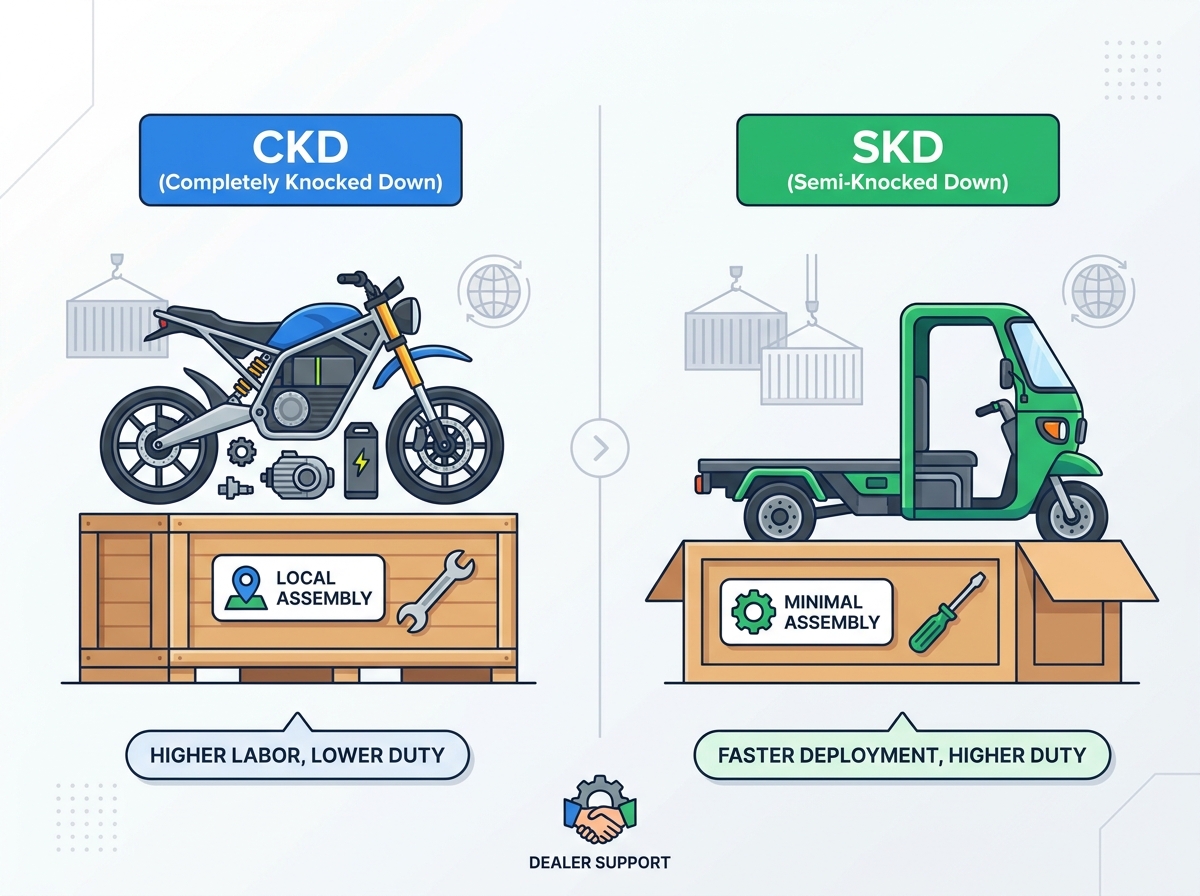
The transition from importing Completely Built Up (CBU) vehicles to localized assembly is no longer optional for high-volume importers facing tightening trade regulations and margin compression. You must balance the aggressive import tariffs levied on fully assembled vehicles against the capital expenditure, labor costs, and quality control risks associated with local assembly. Choosing between Semi-Knocked Down (SKD) and Completely Knocked Down (CKD) models dictates your supply chain complexity, facility requirements, and ultimate unit economics. Moving metal across borders requires precision. If you get the assembly strategy wrong, you bleed cash on freight and taxes. If you scale too fast into full manufacturing, overhead will crush your margins. This guide breaks down the technical and financial evaluation criteria for selecting the right assembly import strategy as part of a mature automotive manufacturing development stage.
Tariff Arbitrage vs. CapEx: CKD offers the lowest import duties and highest freight density but requires significant upfront investment in assembly infrastructure, tooling, and skilled labor.
Supply Chain Complexity: Moving from SKD to CKD exponentially increases the number of handoffs; success relies heavily on strict Bill-of-Materials (BOM) control, variant governance, and SKU-level transportation visibility.
Quality and Compliance: Localizing assembly shifts the burden of final quality assurance (QA) and homologation compliance from the overseas manufacturer to the local importer.
After-Sales Impact: The chosen assembly method directly impacts local parts inventory, warranty fulfillment, and the overall quality of dealer support.
Defining the Baseline: CBU, BUX, SKD, and CKD in EV Manufacturing
Establishing the exact point at which an importer should transition from CBU or BUX (Built Up to Export) to partial or full local assembly requires a deep understanding of volume thresholds and tax incentives. Importing fully assembled vehicles offers the path of least resistance. You place an order, the factory builds it, and the finished product rolls off a ship ready for retail. This convenience carries heavy penalties in the form of maximum import duties and inefficient freight utilization. As sales volumes grow, the financial burden of these inefficiencies forces a strategic shift toward localized assembly.
Semi-Knocked Down (SKD) Realities
SKD involves vehicles exported with major assemblies intact. You typically receive a rolling chassis. The frame arrives painted. The main wiring harness is already routed through the chassis. The motor and high-voltage battery are pre-assembled by the overseas manufacturer. Your local facility handles minimal bolting, fluid addition, and final software flashing. This method bridges the gap between importing finished goods and full manufacturing.
Infrastructure requirements for an SKD operation remain relatively light. You need a clean warehouse environment, basic two-post lifting equipment, standard pneumatic or electric hand tools, and minimal specialized labor. The facility operates more like a large-scale dealership service center than a traditional factory. Technicians follow straightforward standard operating procedures to mate the remaining components. They attach the front fork, mount the handlebars, connect the digital display, and bolt on the wheels. They add brake fluid, bleed the hydraulic lines, plug in the diagnostic tool, and flash the local firmware to the battery management system.
Rapid time-to-market drives the SKD strategy. Importers launch operations quickly with lower initial investment while avoiding the maximum CBU tariff rates. You bypass the complex engineering challenges of welding and painting. Your team focuses entirely on distribution and sales network expansion. SKD serves as a stepping stone, allowing organizations to build local technical competency before committing to heavier industrial processes.
Completely Knocked Down (CKD) Realities
CKD represents a massive leap in operational complexity. Vehicles are exported as loose, individual components. You receive unpainted steel tubes, bare motors, separate wiring harnesses, and individual suspension linkages. This requires comprehensive local manufacturing processes to transform raw parts into a road-legal vehicle.
Infrastructure requirements scale dramatically. A CKD plant demands heavy industrial zoning. You need reinforced concrete floors to support heavy machinery and three-phase power drops for industrial equipment. The facility requires welding stations equipped with precision alignment jigs. You must install environmentally controlled e-coat baths and powder-coating booths. Advanced end-of-line testing rigs are mandatory. You need highly trained technicians capable of handling high-voltage systems safely. You are no longer just an importer; you are a domestic manufacturer. The facility requires rigorous industrial engineering, specialized tooling for every variant, and strict safety protocols.
Maximum tariff reduction justifies the CKD investment. Governments heavily incentivize this approach because it creates local manufacturing jobs and transfers technical skills to the domestic workforce. You achieve optimal shipping container utilization since loose parts pack much denser than assembled frames. Achieving full CKD status often qualifies the final product for government manufacturing subsidies, providing a massive competitive advantage in retail pricing.
Core Evaluation Dimensions for Importing Electric Motorcycles
Analyzing the direct financial and operational trade-offs between these two methodologies dictates your success when scaling a fleet of electric motorcycles. The decision matrix extends far beyond simple shipping costs. You must evaluate tax law, labor dynamics, and industrial real estate availability.
Import Tariffs and Tax Implications
Calculating the delta between SKD and CKD import duties in target jurisdictions forms the foundation of your financial model. Emerging markets impose aggressive taxes on fully assembled vehicles to protect domestic industries. An SKD kit might see a moderate reduction in these duties. A true CKD kit enters the country under raw material or industrial component tax brackets, which are significantly lower.
Conducting a cost ratio analysis determines the exact break-even point. You must calculate when local assembly costs remain lower than the extreme import taxes levied on fully assembled vehicles. If a target country levies a massive tax on CBU imports, the heavy capital expenditure required for a CKD plant might pay for itself within the first two years of operation. In regions with flat tariff structures, the financial incentive to localize assembly evaporates entirely.
Understanding local value-add requirements is equally critical. Governments do not hand out CKD tax benefits freely. They mandate a specific percentage of domestic labor or locally sourced material to qualify for the lowest tax brackets. You might need to source tires, lead-acid batteries, or seat materials locally to hit this threshold. Navigating changing customs classifications and ensuring accurate harmonized system (HS) codes for EV components mitigates the risk of sudden border delays or retroactive tax penalties. Finished electric bikes often fall under HS code 8711.60, while loose electric motors fall under 8501. The tax delta between these codes drives your entire assembly strategy.
Freight Density and Shipping Costs
Container utilization metrics heavily favor disassembly. Comparing the number of units that fit in a standard 40ft High Cube container under SKD versus CKD configurations reveals massive logistical savings. A fully assembled motorcycle ships mostly air. An SKD configuration improves this by allowing tighter packing, but a CKD configuration maximizes every cubic inch of the container.
Assembly Configuration
Average Units per 40HQ Container
Freight Efficiency Rating
Packaging Complexity
Completely Built Up (CBU)
30 - 40 Units
Poor (Shipping mostly air)
Low (Standard roll-on/roll-off or basic crates)
Semi-Knocked Down (SKD)
70 - 90 Units
Moderate
Medium (Requires custom wooden crating)
Completely Knocked Down (CKD)
180 - 220 Units
Excellent (Maximum density)
High (Requires specialized steel racking and VCI bags)
When shipping CKD, bare frames stack tightly together on custom steel racks. Motors pack into dense, heavy-duty crates. Wiring harnesses ship in bulk boxes. This density drastically reduces the per-unit freight cost. You must assess the packaging costs carefully. Specialized racking and protective packaging required for loose CKD components add an upfront expense. Partially assembled SKD units require less complex internal crating. The freight savings of CKD must offset the increased cost of specialized export packaging and the labor required to unpack and sort thousands of individual parts upon arrival.
Local Assembly Infrastructure and Labor Costs
Capital expenditure modeling dictates feasibility. Estimating the cost of establishing an SKD assembly line versus a full CKD manufacturing plant reveals a massive financial gap. An SKD line requires warehouse space, basic lifts, and hand tools. A CKD plant requires reinforced concrete floors, high-voltage electrical drops, ventilation for paint booths, and specialized welding jigs.
Productivity benchmarking requires honest assessment. You must weigh the high manufacturing efficiency and scale of overseas EV OEMs against local labor productivity. The overseas factory has likely built hundreds of thousands of identical units. Your new local assembly team faces a steep learning curve. Initial production runs will be slow. Defect rates will initially be higher than factory-built units. You must implement strict quality control gates at every station.
Labor market analysis determines operational viability. Evaluating the availability and cost of skilled technicians required for high-voltage battery handling and EV drivetrain integration is mandatory. You cannot staff a CKD plant entirely with unskilled labor. You need industrial engineers, quality control specialists, and technicians who understand Controller Area Network (CAN) bus diagnostics. If the local labor market lacks these skills, your training costs will skyrocket, delaying profitability.
Evaluating Electric Cargo Tricycle Import Options
Applying the SKD/CKD framework to commercial and utility EVs presents distinct logistical challenges. When evaluating electric cargo tricycle import options, the physical dimensions of the vehicles force a complete re-evaluation of standard two-wheeler strategies.
Complexity of Commercial EV Assembly
Dimensional challenges make CKD highly attractive for commercial tricycles. The bulky nature of cargo boxes, extended flatbeds, and reinforced chassis creates massive freight inefficiencies if shipped assembled. A standard two-wheeler ships efficiently in an SKD format, but a cargo tricycle consumes vast amounts of container space. Breaking these vehicles down into flat-packed chassis components and nested cargo panels yields extraordinary freight savings. The rear axle, differential, and leaf spring suspension are heavy, bulky items that demand dense packing strategies.
Customization at the destination provides another major advantage. Commercial fleets rarely want a one-size-fits-all solution. Using CKD allows for localized modifications. You import the core cab and chassis, then fit different cargo boxes, specialized refrigeration units, or heavy-duty flatbeds based on local fleet requirements. You can source the steel flatbed or the insulated fiberglass delivery box locally. This flexibility allows importers to serve multiple commercial sectors using a single imported base platform while simultaneously boosting the local value-add percentage for tax purposes.
Quality Assurance and Bill-of-Materials (BOM) Control
Managing strict variant governance becomes critical when assembling commercial fleets. Different customers require specific payload capacities, chassis reinforcements, or extended battery ranges. The local assembly plant must maintain absolute control over the BOM to ensure the right components mate with the right chassis. A mix-up in suspension components on a heavy-duty cargo vehicle leads to catastrophic failure in the field.
Establishing local testing protocols for heavy-duty motors and high-capacity battery packs is mandatory before final delivery. Commercial vehicles endure harsh duty cycles. The local QA team must validate torque output on a dynamometer. They must test battery thermal management under maximum payload conditions. They must verify the IP67 waterproof ratings of all high-voltage connectors using a water spray booth. You cannot rely solely on the overseas manufacturer's QA when you are responsible for the final assembly of a commercial-grade vehicle.
Supply Chain Visibility and Operational Risks
Addressing the specific vulnerabilities introduced by disassembling vehicles for international transit is the most challenging aspect of localization. When you break a vehicle down into thousands of pieces, the risk of disruption multiplies exponentially.
SKU-Level Transportation Tracking
The necessity of granular tracking cannot be overstated. CKD processes fail without real-time visibility into individual component shipments. If you import fully assembled vehicles, a delayed container means delayed revenue. If you import CKD kits, a delayed container holding a specific sub-component halts the entire assembly line. You cannot build a vehicle without its motor controller or steering stem. If you are missing the specific M8x1.25 torque-to-yield bolts for the brake calipers, production stops. You cannot run to a local hardware store for automotive-grade fasteners.
Integrating supplier ERPs with local inventory management systems prevents production line halts. You must know exactly which components are on the water, which are in customs, and which are sitting in safety stock. This level of integration requires sophisticated software, Advanced Shipping Notices (ASN), and barcode scanning at the receiving dock. Manual tracking via spreadsheets inevitably leads to missing critical components and expensive factory downtime.
Managing Missing, Damaged, or Defective Components
Establishing Service Level Agreements (SLAs) with overseas OEMs for rapid replacement of parts damaged in transit is a non-negotiable requirement. Parts get damaged during ocean freight. Salt air causes flash rust on bare metal CKD parts unless they are sealed in Volatile Corrosion Inhibitor (VCI) bags. Rough seas crack plastic fairings. Your SLA must dictate how quickly the factory air-freights replacement parts to keep your line moving.
Calculating the necessary buffer inventory of loose parts maintains continuous CKD assembly operations. This safety stock requirement ties up working capital but acts as an insurance policy against supply chain shocks. You need a safety stock of at least 5-10% for fragile or critical components. If a batch of brake calipers arrives out of spec, your safety stock allows production to continue while you resolve the quality dispute with the supplier. Without safety stock, a single defective batch paralyzes your entire operation.
The Impact of Assembly Methods on Dealer Support
Upstream import decisions profoundly affect downstream customer satisfaction and retail network viability. The way you build the vehicle dictates how well you can maintain it in the field. Exceptional dealer support hinges entirely on parts availability and technical knowledge.
Warranty Fulfillment and Spare Parts Availability
Operating a CKD facility naturally creates a robust, localized inventory of spare parts. Because you import loose components by the thousands, you inherently build a massive parts warehouse. This drastically reduces warranty repair lead times. When a dealer needs a replacement stator, a specific suspension linkage, or a DC-DC converter, the part is already in the country. It sits on a shelf in your assembly plant. You ship it to the dealer overnight, getting the customer back on the road immediately.
The challenge of SKD lies in avoiding the trap of cannibalizing new kits. Because SKD involves importing pre-assembled modules, you rarely have a deep inventory of individual loose parts. When a warranty claim arises, the temptation is to strip a part off a brand-new SKD kit to fix the customer's vehicle. This ruins the inventory integrity of the new kit, creating a cascading logistical nightmare. CKD eliminates this trap entirely by ensuring a constant flow of individual components.
Technical Training and Network Enablement
Leveraging the local assembly plant as a training ground for dealership technicians creates a highly capable service network. Dealership mechanics visit the plant and watch the vehicles being built from the ground up. They see exactly how the wiring harness routes through the frame. They learn how the battery management system communicates with the motor controller. This hands-on exposure is invaluable for advanced diagnostics. They return to their dealerships as master technicians.
Translating factory-level assembly knowledge into comprehensive dealer support documentation elevates the entire network. Your local assembly engineers understand the vehicle better than anyone else in the country. They write detailed diagnostic troubleshooting guides, create accurate wiring diagrams, and produce video tutorials for common repairs. This localized knowledge transfer empowers dealers to handle complex repairs confidently, reducing the burden on your central technical support team.
Conclusion
Audit your local customs tariff schedule to identify the exact duty rate differences between fully assembled vehicles and loose industrial components.
Request a comprehensive Bill of Materials and a flat-pack container utilization plan from your overseas manufacturing partner to calculate precise freight savings.
Calculate the exact square footage, floor load capacity, and electrical requirements needed for a local assembly facility based on your projected annual volume.
Establish a local sourcing strategy for high-weight, low-complexity items like tires and lead-acid batteries to meet domestic value-add tax thresholds.
FAQ
Q: What is the primary difference between SKD and CKD for electric vehicles?
A: The main difference lies in the level of disassembly. SKD involves importing major pre-assembled modules, such as a painted frame with the motor already attached, requiring minimal local labor. CKD involves importing entirely loose components. This requires full factory assembly, including welding, painting, and extensive end-of-line testing.
Q: How do import tariffs differ between CBU, SKD, and CKD?
A: CBU vehicles generally attract the highest luxury or import taxes to protect domestic manufacturing. SKD offers moderate tariff reductions because some local labor is required. CKD generally qualifies for the lowest raw material or industrial component tax rates, and often makes the vehicle eligible for local manufacturing subsidies.
Q: What is the automotive manufacturing development stage?
A: This refers to the phased maturity model of an importer. Businesses typically start by importing CBU or BUX vehicles to test the market. As volume grows, they transition to SKD assembly to reduce tariffs. Eventually, they evolve into full CKD localization as their technical capabilities and market share justify the heavy infrastructure investment.
Q: Does assembling electric motorcycles locally affect homologation?
A: Yes. Local assembly shifts the responsibility of meeting national safety and road-worthiness standards directly to the importer. You are no longer just selling an approved foreign product; you are manufacturing a local one. This requires local facility audits, rigorous product testing, and maintaining strict compliance documentation.
Q: What are the hidden costs of a CKD import strategy?
A: Beyond the obvious factory space, hidden costs include specialized tooling for every vehicle variant, high-voltage safety equipment for technicians, and complex SKU-level inventory management software. Maintaining a buffer stock of loose parts to replace components damaged in transit ties up significant working capital.
Q: Can an importer transition from SKD to CKD over time?
A: Yes, this is the standard industry trajectory. Importers use SKD to build market share, establish a dealer network, and generate cash flow. Once sales volumes reach a critical mass that justifies the capital expenditure, they upgrade their facilities and transition to CKD to maximize margins and secure government manufacturing incentives.
Q: How does CKD assembly improve dealer support?
A: Importing loose components inherently builds a comprehensive local spare parts inventory. Instead of waiting weeks for a part from overseas, dealers receive replacements overnight from the local assembly plant. The local assembly team develops deep technical familiarity with the product, enabling them to provide superior diagnostic support to the retail network.
Beneath the Tianshan Mountains in June, sweet fruits fill the air and bustling business exchanges thrive. On June 25, 2026, the 9th China-Eurasia Expo grandly kicked off in Urumqi, Xinjiang. As an influential comprehensive international event along the Belt and Road Initiative, this year’s expo hit
From May 26 to 29, the highly anticipated "Comprehensive Upgrade, Leading the Future with Intelligence" JP Group 2026 Business Summit & New Product Launch grandly kicked off at Xiamen International Expo Center.
The transition from importing Completely Built Up (CBU) vehicles to localized assembly is no longer optional for high-volume importers facing tightening trade regulations and margin compression.
Quotation Lists Available
We have different quotation lists and professional purchasing & sales team to answer your request fast.