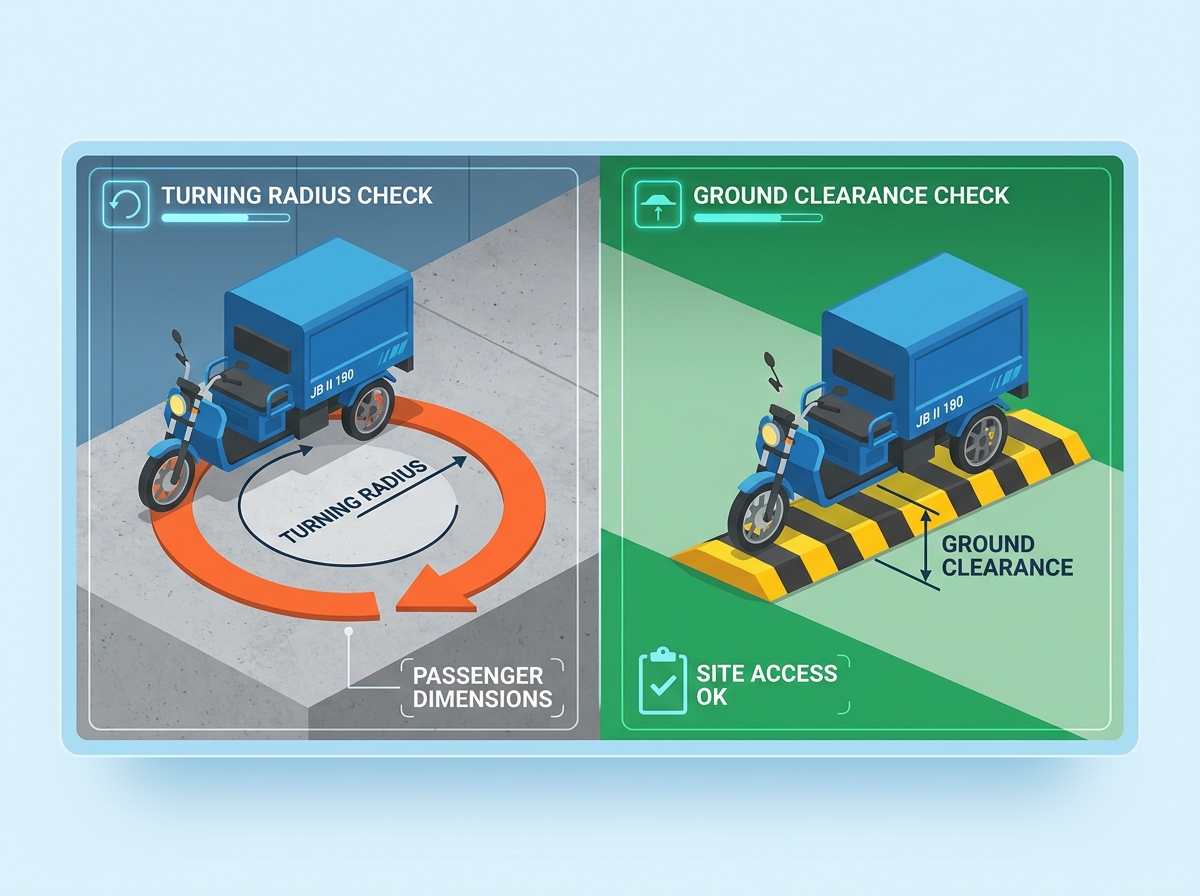
The success of a micro-mobility fleet depends entirely on its physical compatibility with the deployment environment. Procuring commercial trikes based solely on payload and battery specs is a costly mistake. You might buy a fleet only to discover the units cannot navigate tight warehouse aisles, clear loading ramps, or fit through standard facility doors. These physical mismatches create severe bottlenecks. They damage infrastructure and delay routing.
A systematic approach to evaluating turning radius, ground clearance, and frame dynamics prevents these operational failures before procurement. By auditing facility choke points, operators match vehicle geometry directly to their environmental constraints. We will look at how to measure and select electric cargo tricycles that physically fit the realities of your operational space.
Key Takeaways
Static vs. Dynamic Metrics: Manufacturer turning radius and ground clearance specs often reflect unloaded vehicles; real-world operational dimensions change significantly under maximum payload and tire compression.
The Breakover Angle Factor: High ground clearance is irrelevant if the wheelbase is too long, causing the chassis to high-center on steep ramps or speed bumps.
Choke Point Auditing: Accurate site measurement must account for the widest point of the tricycle (usually the rear axle or cargo box) during a maximum-angle turn, not just straight-line width.
The "Zero-Turn" Reality Check: While some consumer models boast a "zero turning radius," commercial electric cargo tricycles require specific differential or dual-motor setups to achieve ultra-tight turns without compromising stability.
Application-Specific Geometry: Passenger tricycle dimensions prioritize stability and comfort, whereas cargo models prioritize load distribution, fundamentally altering their maneuverability profiles.
Why Site Access Metrics Make or Break Electric Cargo Tricycle Deployments
Successful site access means a vehicle moves through a facility without causing structural damage, forcing operators to reverse in single-direction aisles, or getting stuck on standard dock plates. When a vehicle fits its environment, operators maintain consistent speeds. They focus entirely on load management and delivery schedules. Physical compatibility eliminates complex maneuvering. It reduces the risk of collisions with racking systems, door frames, and pedestrians walking in shared corridors.
Inadequate maneuverability introduces heavy operational friction. When a turning radius is too wide for a specific aisle, operators must execute multi-point turns. These maneuvers consume time and block high-traffic areas. Over an entire shift, the seconds lost to reversing and realigning accumulate into massive delays. Wrestling a heavily loaded tricycle through tight spaces accelerates operator fatigue. Fatigued drivers make handling errors, which increases workplace accidents and product damage.
Engineers face a constant compromise between maintaining a low center of gravity and providing sufficient ground clearance. Heavy payloads require a low center of gravity to prevent rollovers during sharp turns. Lowering the chassis reduces the clearance needed to navigate uneven terrain, speed bumps, and transition ramps. Selecting the right vehicle means finding the exact balance point. The chassis must be low enough for stability but high enough to clear your facility's specific floor transitions.
Consider the daily route of a warehouse delivery trike. It might start on a smooth concrete floor, transition over a steep steel dock plate, navigate a gravel yard, and then enter a narrow service elevator. Each of these environments demands specific geometric traits from the vehicle. Failing to account for just one of these choke points renders the vehicle useless for that specific route.
Site Access Failure
Root Cause
Operational Impact
High-Centering on Ramps
Wheelbase too long for the breakover angle.
Vehicle gets stuck; potential damage to undercarriage and battery.
Steering angle too restricted for 90-degree corners.
Severe route delays, operator fatigue, blocked traffic flow.
Bottoming Out
Dynamic clearance drops too low under max payload.
Cracked welds, destroyed mid-drive motors, bent axles.
Evaluating Turning Radius in Electric Cargo Tricycles
The geometry of three-wheeled vehicles dictates their turning capabilities. The distance between the front and rear axles, known as the wheelbase, combines with the maximum steering angle to determine the minimum turning circle. A shorter wheelbase allows for a tighter turn. It sacrifices straight-line stability at higher speeds. Track width, the distance between the two parallel wheels, also impacts the arc of the turn. Wider tracks require more space to pivot, especially in confined indoor environments.
Tricycle configurations fall into two primary categories: Delta and Tadpole. Delta designs feature one wheel in the front and two in the rear. This configuration offers a tighter turning radius. It is superior for indoor warehouse navigation where 90-degree aisle turns are common. The single front wheel can often turn at a very sharp angle, pulling the front of the vehicle around tight corners. Tadpole designs place two wheels in the front and one in the rear. Tadpoles provide exceptional stability during high-speed cornering. Their steering linkage restricts the maximum wheel angle. This results in a wider turning circle that struggles in narrow corridors.
Tight turns directly impact steering column resistance and operator balance. A smaller turning radius demands a highly responsive steering mechanism. If the steering is too heavy, operators will struggle to execute sharp turns under load. If the steering is too loose, the vehicle becomes twitchy and prone to tipping. Well-balanced steering geometry ensures the operator can safely pivot the vehicle without shifting their weight drastically to maintain stability.
Marketing materials frequently tout "zero turning radius" capabilities. True zero-turn requires independent rear-wheel drive. It utilizes differential steering where one wheel spins forward while the other spins backward. Standard commercial trikes rarely achieve this safely under full load. Most utilize a solid rear axle or a standard differential that requires forward motion to pivot. Expecting true zero-turn from a standard cargo model leads to severe operational miscalculations during deployment.
Buyers must validate manufacturer turning claims through real-world testing. Specifications often list the "curb-to-curb" turning radius. This only measures the path of the tires on the ground. Facility managers need the "wall-to-wall" measurement. This metric accounts for the overhang of the cargo box, handlebars, and the operator's elbows. During a tight turn, a cargo box extending past the rear axle sweeps a much wider arc than the tires. It will easily clip warehouse racking if not properly accounted for.
Measure the Aisle: Determine the exact width of your narrowest intersecting aisles.
Check the Overhang: Measure the distance from the rear axle to the furthest back edge of the cargo box.
Calculate the Sweep: Add the overhang to the manufacturer's stated turning radius to estimate the true wall-to-wall requirement.
Test with Chalk: Attach a piece of chalk to the outermost rear corner of the cargo box and execute a full-lock turn on pavement to see the actual physical arc.
Ground Clearance Requirements for Commercial Environments
Navigating facility infrastructure requires precise clearance calculations. You must evaluate approach angles, departure angles, and breakover angles. The approach angle determines if the front tire can touch a ramp before the front bumper scrapes the ground. The departure angle applies the same logic to the rear. The breakover angle is the most critical metric for long-wheelbase vehicles. It dictates whether the center of the chassis will clear the peak of a ramp or a high speed bump without high-centering.
Static ground clearance specifications are deceptive. When you load a vehicle to its maximum capacity, the suspension compresses. Heavy payloads cause tire deflection, flattening the rubber against the pavement. This dynamic clearance reduction easily shaves one to two inches off the static measurement. Procurement calculations must include a generous buffer to account for this compression. The vehicle must still clear obstacles when fully loaded with heavy materials.
The main frame bears the immense stress of acceleration, braking, and road vibration. Inadequate ground clearance exacerbates chassis fatigue. When a heavily loaded vehicle bottoms out on uneven surfaces or dock plates, the impact sends shockwaves directly through the rigid frame. Over time, these repeated impacts cause micro-fractures in the welds. This leads to catastrophic structural failure and costly downtime.
Low-mounted components remain highly vulnerable in industrial settings. Mid-drive motors, under-carriage battery casings, and derailleurs sit dangerously close to the ground. Striking a concrete transition or a piece of debris destroys these expensive parts instantly. In environments with degraded concrete, gravel, or steep transitions, vehicles require heavy-duty bash guards or reinforced skid plates. These additions protect critical investments from inevitable impacts.
Consider the specific obstacles in a standard industrial park. Speed bumps are typically 3 to 4 inches high. A trike with 5 inches of static ground clearance might seem adequate. Once you add a 600-pound payload and a 200-pound operator, the suspension sags by 1.5 inches. The tires deflect by another 0.5 inches. Your dynamic clearance is now exactly 3 inches. The moment that trike hits the speed bump at anything faster than a crawl, the suspension compresses further, and the motor housing slams into the concrete.
Comparing Passenger Tricycle Dimensions vs. Cargo Models
Structural differences dictate how these vehicles access physical spaces. When evaluating passenger tricycle dimensions, you will notice wider track widths designed specifically for rollover prevention. They feature longer wheelbases to accommodate legroom and seating arrangements. Cargo chassis focus on vertical load stacking. They utilize narrower track widths and shorter wheelbases to maximize maneuverability in tight spaces. They compromise passenger comfort for operational efficiency.
Certain niche scenarios justify repurposing a passenger chassis for utility work. Resort campuses, wide-aisle fulfillment centers, and expansive outdoor facilities lack the severe space constraints of tight urban warehouses. In these environments, the wider turning geometry of a modified passenger frame poses no operational barrier. The enhanced stability provided by the wider track width benefits operators moving bulky, low-density materials across open, uneven terrain.
Center of gravity dynamics differ vastly between the two designs. Passenger weight shifts dynamically during turns. Human occupants lean and move. This requires a wider, more forgiving chassis to maintain balance. Cargo weight remains static. Once strapped down, a palletized load does not shift its center of mass independently. This static nature allows cargo models to execute tighter, faster turns safely, provided the load is kept low and centered over the rear axle.
A standard passenger trike might have a rear track width of 45 inches to keep tourists from tipping it over on a sharp corner. A warehouse cargo trike might have a rear track width of just 34 inches. That 11-inch difference determines whether the vehicle can pass through a standard commercial doorway or navigate between closely packed assembly line stations.
The Site Access Checklist: Pre-Procurement Audit
Measuring facility choke points is the first mandatory step before vehicle selection. Use a laser measure to record the exact width of your narrowest warehouse aisles, service elevators, and pedestrian gates. Pay special attention to 90-degree blind corners. Measure the diagonal distance required to clear the corner. Account for the sweeping arc of a fully loaded cargo box. Document these measurements as your absolute maximum vehicle dimensions.
Assessing incline angles prevents undercarriage damage. Measure the grade of all loading ramps and the severity of floor transitions. Use an angle finder to determine the peak angle of your steepest ramp. Compare this directly against the breakover angle of your shortlisted vehicles. If the ramp angle exceeds the vehicle's breakover capacity, the chassis will drag. This causes immediate damage to the frame or battery housing.
Surface conditions dictate suspension travel requirements. Cobblestones, degraded warehouse concrete, and loose gravel demand specific ground clearance minimums. Uneven surfaces cause the vehicle to pitch and roll, temporarily reducing clearance on one side. Vehicles operating on rough terrain require longer suspension travel and higher static clearance. This prevents the chassis from striking the ground during heavy lateral movements.
Implement a strict pre-ride inspection for all demo units. Verify tire pressure meticulously. Under-inflated tires drastically alter dynamic clearance and turning resistance. Inspect the integrity of skid plates before testing on ramps. Ensure all lights and reflectors are positioned high enough to remain visible when navigating tight, dark warehouse aisles. They should not be obscured by low-level racking systems.
Mitigate implementation risks by setting up a physical cone course. Replicate your facility's exact dimensions in an open parking lot. Recreate your narrowest aisles, sharpest corners, and standard door widths. Force operators to navigate this course with a fully loaded demo unit. This physical validation exposes maneuverability failures immediately. It prevents the costly mistake of purchasing a fleet that cannot function within your walls.
Audit Category
Measurement Focus
Operational Impact
Choke Point Width
Narrowest doors, aisles, gates
Determines maximum allowable track width.
Cornering Clearance
90-degree turns, blind corners
Dictates required wall-to-wall turning radius.
Ramp Angles
Peak inclines, dock plates
Establishes minimum breakover angle requirements.
Surface Quality
Potholes, gravel, transitions
Defines necessary suspension travel and skid plate needs.
Dynamic Load Drop
Clearance at max payload
Prevents bottoming out under heavy operational stress.
Model Evaluation: The JB II 180 Cargo Tricycle
Analyzing the specifications of the JB II 180 cargo tricycle provides a practical baseline for commercial evaluation. This model features a robust frame designed specifically for heavy payload transport. Its wheelbase and track width are engineered to balance load stability with functional maneuverability. The ground clearance handles standard urban obstacles. The turning radius reflects a traditional Delta configuration optimized for utility rather than tight indoor pivoting.
The maneuverability profile of this specific geometry excels in semi-constrained environments. The steering linkage provides enough leverage to turn heavy loads without excessive operator strain. The overall length of the cargo bed means the wall-to-wall turning radius requires careful calculation. The rear overhang sweeps a wider path than the front wheel. This demands operator awareness when navigating around tight corners or parked vehicles in urban delivery scenarios.
Objective evaluation reveals clear operational boundaries. A model with these dimensions thrives in urban last-mile delivery, campus maintenance, and wide-aisle industrial facilities. It handles curb transitions and standard ramps effectively. It faces site access failures in hyper-dense indoor environments, such as narrow-aisle fulfillment centers or facilities requiring navigation through standard 36-inch pedestrian doors. Buyers must align these specific physical traits with their documented site audit.
Conclusion
Electric cargo tricycles only work if they can physically navigate your specific facility. Ignoring turning radius and ground clearance guarantees operational friction, damaged infrastructure, and wasted capital. You must match the vehicle to the environment.
Map your facility with a laser measure to record all choke points and aisle widths.
Calculate the breakover angle of your steepest ramps and dock plates using an angle finder.
Build a physical cone course in your yard that mimics your tightest indoor corners.
Test fully loaded demo units on the cone course to verify the true wall-to-wall turning radius.
Install heavy-duty skid plates on your final fleet if your route includes steep transitions or degraded concrete.
FAQ
Q: What is the average turning radius of an electric cargo tricycle?
A: The turning radius typically ranges from 80 to 150 inches. Compact warehouse models with a Delta configuration pivot tightly, often staying under 90 inches. Heavy-duty urban delivery models with longer wheelbases and wider tracks require significantly more space, pushing toward the 150-inch mark.
Q: Do electric cargo tricycles really have a zero turning radius?
A: Commercial cargo trikes rarely have a true zero turning radius. Achieving it requires specialized independent dual-motor rear axles. Commercial models prioritize stability and traction under heavy loads, which usually precludes ultra-tight, pivot-in-place capabilities.
Q: How does payload weight affect a tricycle's ground clearance?
A: Maximum payload weight compresses the suspension system and causes tire deflection. This dynamic load drop reduces static ground clearance by one to two inches. Operators must account for this reduction to prevent bottoming out on ramps and speed bumps when fully loaded.
Q: How does motor and battery placement affect ground clearance?
A: Mid-drive motors and under-deck batteries lower the vehicle's center of gravity, greatly improving balance and cornering stability. This placement inherently reduces overall ground clearance, making these expensive components vulnerable to strikes and requiring protective skid plates.
Q: What is the difference between curb-to-curb and wall-to-wall turning radius?
A: Curb-to-curb measures only the path of the tires on the ground. Wall-to-wall accounts for the physical overhang of the cargo box, handlebars, and chassis. Wall-to-wall is the critical metric for indoor use, as it represents the true space required to clear a turn.
Q: Can electric cargo tricycles fit through standard commercial doors?
A: Standard commercial doors are typically 36 inches wide. Most heavy-duty cargo tricycles have track widths exceeding 38 inches and will not fit. Only specific, ultra-compact models designed explicitly for indoor facility navigation can clear standard pedestrian doorways.
Q: How do I calculate the breakover angle for my facility ramps?
A: The breakover angle is dictated by the tricycle's wheelbase length and its ground clearance. To prevent bottoming out, the peak angle of your ramp must be less than the maximum angle the vehicle's undercarriage can clear without the center of the chassis striking the ground.
Beneath the Tianshan Mountains in June, sweet fruits fill the air and bustling business exchanges thrive. On June 25, 2026, the 9th China-Eurasia Expo grandly kicked off in Urumqi, Xinjiang. As an influential comprehensive international event along the Belt and Road Initiative, this year’s expo hit
From May 26 to 29, the highly anticipated "Comprehensive Upgrade, Leading the Future with Intelligence" JP Group 2026 Business Summit & New Product Launch grandly kicked off at Xiamen International Expo Center.
The transition of last-mile delivery logistics toward micro-mobility is accelerating rapidly. Urban congestion, strict emission regulations, and the constant demand for lower per-stop delivery costs drive this operational shift.
Quotation Lists Available
We have different quotation lists and professional purchasing & sales team to answer your request fast.