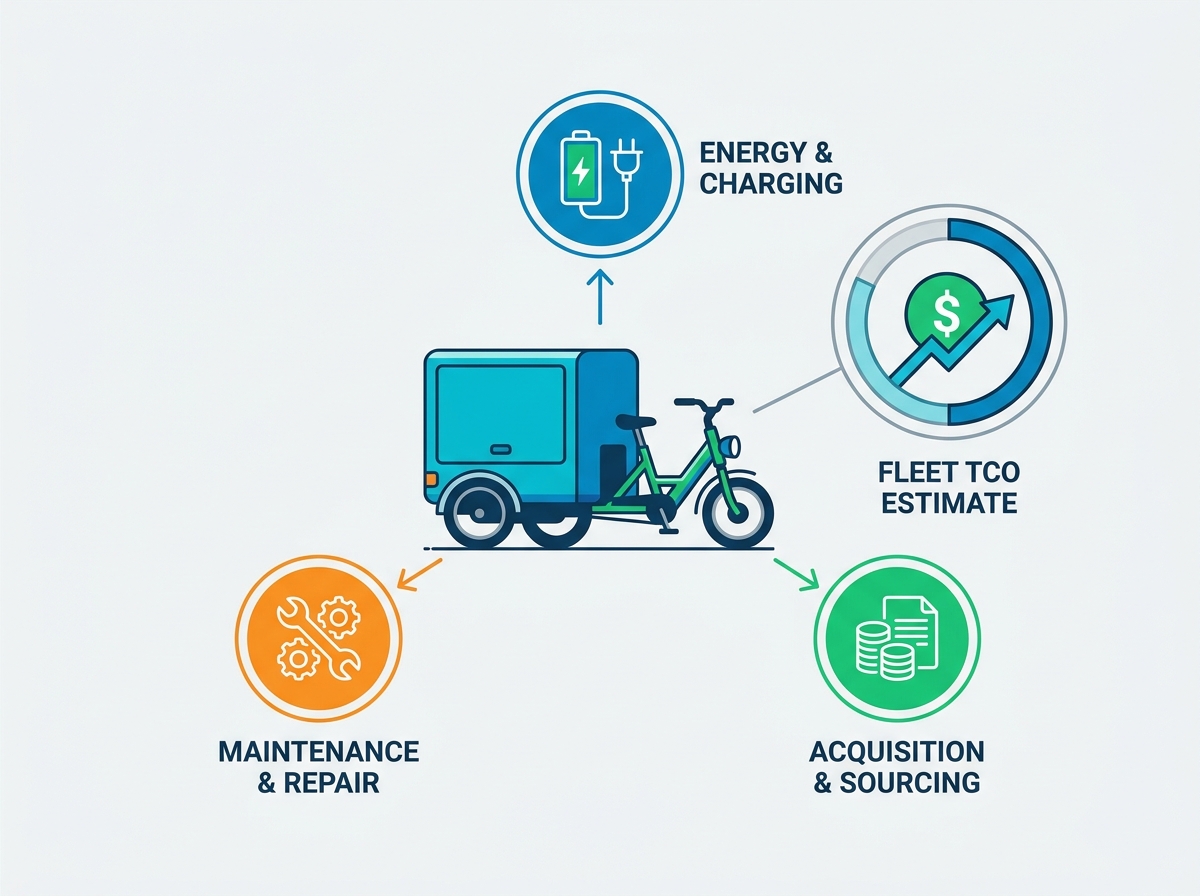
The transition of last-mile delivery logistics toward micro-mobility is accelerating rapidly. Urban congestion, strict emission regulations, and the constant demand for lower per-stop delivery costs drive this operational shift. Fleet operators frequently miscalculate the financial viability of micro-mobility programs. They often focus solely on the initial purchase price of the vehicles. This narrow financial view ignores complex variables like battery lifecycle degradation, specialized mechanical upkeep, and necessary facility infrastructure adaptations. To determine if a micro-mobility transition is financially sound, operations leaders must move beyond basic return-on-investment calculators. You need to build a comprehensive lifecycle cost model specific to the operational realities of electric cargo tricycles. We will break down the exact direct and indirect expenses required to run these fleets effectively on city streets.
CapEx vs. OpEx Shift: While electric cargo tricycles require lower initial capital than electric vans, their operational expenses are heavily front-loaded by charging infrastructure and battery replacement schedules.
Direct vs. Indirect Cost Tracking: A mature operating cost model must explicitly separate direct costs (vehicle acquisition, energy, parts) from indirect costs (administrative overhead, rider training, and downtime penalties).
Maintenance Realities: True lifecycle costs must account for high-frequency wear-and-tear components (brakes, tires, drivetrains) that degrade faster under maximum payload conditions in urban environments.
Downtime is the Hidden Metric: Accurate cost modeling requires factoring in vehicle redundancy, charging downtime, and specialized mechanic availability to prevent service-level agreement (SLA) breaches.
Subsidies Alter the Baseline: Localized tax incentives, grants, and zero-emission zone exemptions significantly compress the payback period, but require strict compliance tracking.
The Financial Framework for Electric Cargo Tricycles
Defining success criteria is the first step in building a reliable financial framework. A successful deployment might mean achieving a targeted reduction in cost-per-delivery compared to internal combustion engine vans. It also requires maintaining high fleet uptime across all delivery shifts. Operations managers must establish clear performance baselines before acquiring assets. You must know exactly what financial metrics determine a successful route transition. Without these baselines, you cannot measure the actual efficiency of your new fleet.
Establishing the core equation requires tracking multiple moving parts. The baseline formula includes acquisition costs, infrastructure investments, operating expenses, and downtime risks. You then subtract residual vehicle value and localized incentives. This equation provides the foundation for your lifecycle cost model. Dynamic modeling is absolutely necessary here. You must forecast expenses over a three-to-five-year lifecycle. Static, day-one calculations fail to capture inevitable battery degradation and sudden maintenance spikes that occur in year two or three of operation.
Conceptual trade-offs dictate your final vehicle selection. You must balance payload capacity and battery range against vehicle weight. Heavier tricycles carry more parcels but drain batteries faster and maneuver poorly in tight bike lanes. Consider regulatory classifications carefully. Standard e-bikes differ significantly from light electric vehicles regarding licensing, insurance, and access to pedestrian zones. These regulatory differences directly impact your daily operating expenses and determine where your riders can legally park during deliveries.
Cost Category
Static Modeling Approach
Dynamic Lifecycle Approach
Battery Life
Assumes constant range over 3 years
Models 20% range degradation annually
Maintenance
Flat monthly estimate
Scales upward as mileage accumulates
Energy Costs
Fixed utility rate
Factors in seasonal rate hikes and peak charges
Downtime
Ignored or assumed zero
Calculates SLA penalties and substitute rentals
Capital Expenditures (CapEx): Acquisition and Infrastructure
Vehicle Purchase Costs and Fleet Sourcing Requirements
Evaluating base unit costs requires distinguishing between consumer-grade retrofits and purpose-built commercial trikes. Consumer models modified for cargo fail quickly under daily commercial strain. Commercial units feature reinforced frames, hydraulic disc brakes, and heavy-duty suspension systems. These upgrades prevent catastrophic frame failures during maximum payload operations. A snapped frame mid-route costs far more in lost client trust than the initial savings of buying a cheaper, consumer-grade chassis.
Defining strict fleet sourcing requirements protects your initial capital investment. Look for strong manufacturer warranty terms that cover commercial use specifically. Localized parts availability is critical for maintaining high fleet uptime. Waiting weeks for overseas shipping on a proprietary axle keeps your vehicle off the road and drains revenue. Minimum order quantity discounts help scale operations efficiently as you expand into new delivery zones. Always demand a clear supply chain roadmap from your manufacturer before signing a procurement contract.
Customization adds immediate upfront costs but improves operational efficiency. Telematics hardware integration provides essential data for tracking vehicle health and rider behavior. Custom cargo boxes suit specific delivery profiles. You might need refrigerated units for grocery fulfillment or secure dry boxes for high-value parcels. Corporate branding ensures fleet visibility but adds to the initial acquisition expense. Factor these modifications into your capital expenditure budget from day one.
Charging Infrastructure and Facility Modifications
Assessing your facility's electrical capacity is a mandatory early step. High-capacity tricycle batteries require specific charging setups. Level 1 charging might suffice for overnight dwells if your routes are short. Level 2 charging accelerates turnaround times for multi-shift operations. You must audit your current electrical panels to determine if they can handle simultaneous charging of twenty or fifty vehicles. Upgrading a depot's main electrical service panel requires municipal permits and significant contractor labor.
Compare battery swapping stations against traditional plug-in charging bays. Swapping stations reduce vehicle downtime significantly, allowing riders to exchange a depleted battery for a full one in minutes. However, swapping infrastructure requires a larger upfront investment and purchasing extra battery packs. Plug-in bays require less initial facility modification but keep vehicles tethered and unproductive for hours. Forecast your future infrastructure needs carefully as your fleet scales across multiple urban depots.
Facility upgrades are non-negotiable when dealing with large lithium-ion battery banks. Lithium-ion storage requires industrial fire suppression systems. Standard sprinkler systems are often insufficient for chemical fires. Secure parking prevents asset theft and vandalism. Proper ventilation systems are necessary to dissipate the heat generated during mass charging cycles in enclosed depot spaces. Failing to upgrade your facility ventilation will lead to overheated chargers and reduced battery lifespans.
Depreciation and Residual Value Assumptions
Micro-mobility assets follow different depreciation schedules than traditional delivery vans. Expect a standard lifecycle of three to five years for a commercial tricycle. The intense daily wear and tear of urban logistics degrades these lighter vehicles faster than heavy-duty trucks. You must accelerate your depreciation models to match this operational reality. Do not apply a ten-year depreciation schedule to a vehicle that jumps curbs and navigates potholes daily.
Battery degradation heavily impacts the secondary market value of these vehicles. A tricycle with a depleted battery retains very little resale value. Buyers on the secondary market discount the vehicle heavily because they must immediately purchase a replacement battery. The chassis and cargo box hold their physical integrity longer, but the powertrain dictates the residual value. Track battery health meticulously if you plan to sell the fleet on the secondary market.
Consider the financial differences between leasing and purchasing. Financing models can shift depreciation risk away from your balance sheet. Leasing often places battery degradation risks back onto the manufacturer or the leasing partner. This arrangement provides predictable monthly expenses and guarantees vehicle replacements at the end of the lease term. Evaluate your company's cash flow requirements to determine which acquisition model fits your operational goals.
Operating Expenses (OpEx): Running Electric Cargo Tricycles
Energy Consumption vs. Traditional Fuel Costs
Calculating your cost per kilometer reveals the immediate advantage of micro-mobility. Compare kilowatt-hour rates against diesel or gasoline equivalents. Electricity generally offers massive per-kilometer savings. However, you must track these charging costs accurately through smart meters to validate your financial model. Do not rely on manufacturer estimates for energy consumption; measure the actual draw at your depot chargers.
Use predictive energy modeling to forecast long-term utility rate changes. Compare these projected electricity rates against volatile fossil fuel prices. This analysis projects accurate lifetime savings for the fleet. Several variables affect daily energy efficiency. Heavy payload weights drain batteries faster. Route topography with steep inclines demands significantly more motor power. A tricycle carrying a maximum payload up a six-percent grade will draw massive amperage, generating heat in the motor controller and draining the battery cells rapidly. Stop-and-go frequency impacts how well regenerative braking systems recover energy. Ambient temperature drops cause severe winter range loss, sometimes reducing battery efficiency by thirty percent.
Implement smart charging strategies to control energy expenses. Utilize off-peak charging schedules to mitigate utility demand charges. Charging fifty vehicles simultaneously during peak afternoon hours will trigger massive demand penalties from your local utility provider. Staggered, overnight charging keeps energy costs predictable and low. Work with your utility provider to install dedicated sub-meters for your charging infrastructure to isolate these costs from your general building electricity usage.
Cargo Tricycle Maintenance and Repair Schedules
Move your operations from preventative to predictive servicing schedules. Use telematics data to monitor component health in real-time. Tracking motor temperature, battery voltage drops, and braking frequency prevents unexpected roadside breakdowns. Predictive servicing keeps vehicles on the road generating revenue. When a motor controller shows consistent overheating patterns, pull the vehicle for inspection before the component fails entirely.
Account for high-frequency replacement costs in your operating budget. Heavy-duty brake pads wear out quickly under maximum payload conditions. Specialized puncture-resistant tires are mandatory for surviving urban street debris. Reinforced drive chains or belts require regular tensioning and lubrication. Proper cargo tricycle maintenance is the only way to keep the fleet operational. Neglecting these high-wear items leads to snapped chains, failed brakes, and injured riders.
Labor costs differ entirely from traditional vehicle fleets. You must hire or train specialized mechanics. They need certification in both heavy-duty bicycle mechanics and high-voltage electrical systems. A standard diesel mechanic cannot true a spoked wheel, and a standard bicycle mechanic should not handle a high-capacity lithium powertrain. Sourcing this specialized labor carries a premium hourly rate. Build a dedicated workspace in your depot equipped with heavy-duty lifts designed specifically for tricycles.
Daily Pre-Trip Inspections: Riders must verify tire pressure, test hydraulic brake response, and confirm the battery casing shows no physical damage before leaving the depot.
Weekly Drivetrain Servicing: Mechanics should clean and lubricate the primary drive chain, check belt tension, and inspect the rear axle alignment to prevent uneven tire wear.
Monthly Electrical Audits: Technicians need to run diagnostic software to check for battery cell imbalances, update motor controller firmware, and inspect all exposed wiring harnesses for chafing.
Quarterly Structural Checks: Inspect the main chassis welds, cargo box mounting points, and steering column bearings for stress fractures caused by heavy urban payloads.
Component
Inspection Frequency
Replacement Interval
Brake Pads (Hydraulic)
Weekly
Every 1 to 2 months
Drive Chain / Belt
Weekly
Every 3 to 6 months
Tires (Puncture-Resistant)
Daily
Every 4 to 6 months
Lithium-Ion Battery
Monthly (Diagnostic)
Every 18 to 24 months
Insurance, Licensing, and Administrative Costs
Manage the complex insurance requirements carefully. Liability coverage is critical for micro-mobility fleets. These vehicles operate constantly in dense pedestrian zones, increasing the risk of low-speed collisions. Standard commercial auto policies rarely cover light electric vehicles appropriately. You need specialized micro-mobility fleet insurance. Work with a broker who understands the specific liability profile of cargo tricycles operating in shared bike lanes.
Regulatory compliance carries ongoing annual costs. Budget for vehicle registration fees and municipal operating permits. Commercial loading zones often require paid access or specific municipal decals. Mandatory safety inspections add to your annual administrative expenses. Failing to maintain compliance results in grounded vehicles and municipal fines. Assign a dedicated fleet administrator to track permit renewals and inspection deadlines.
Do not ignore indirect administrative overhead. Software subscriptions for fleet management are essential for tracking assets. Route optimization platforms maximize daily delivery yields by calculating the most efficient paths. You need dedicated administrative personnel to manage these micro-mobility assets, track compliance, and handle daily rider dispatching. Managing a fleet of fifty tricycles requires robust software; manual spreadsheets will cause dispatch errors and lost revenue.
Hidden Costs, Implementation Risks, and Mitigation
Battery Degradation and Replacement Cycles
Model the true lifespan of lithium-ion batteries under commercial strain. Commercial usage degrades cell chemistry rapidly due to deep discharging and rapid recharging. Expect 500 to 1,000 charge cycles before the battery capacity drops below operational thresholds. Once a battery falls below eighty percent of its original capacity, it often cannot complete a full delivery route. Track charge cycles meticulously through your battery management system.
Budget explicitly for mid-lifecycle battery replacements. This maintains route viability over the vehicle's entire physical lifespan. Failing to replace degraded batteries leads to stranded riders and failed deliveries. You must treat batteries as consumable operating expenses rather than permanent capital assets. Build a replacement schedule into your financial framework from the very beginning.
Implement strict charging protocols for mitigation. Avoid leaving batteries at a maximum state-of-charge when the vehicle sits idle over the weekend. Keep charge levels balanced between twenty and eighty percent when possible to extend overall battery health. Train your depot staff on proper thermal management during charging sequences. Never charge a lithium battery immediately after a shift when the cells are still hot from heavy use.
Rider Training and Turnover Costs
Rider turnover significantly impacts financial models. Recruitment, onboarding, and safety training consume human resources and capital. High turnover inflates these operational expenses continuously. Operating a cargo tricycle requires physical stamina and situational awareness, leading to higher burnout rates than driving a climate-controlled van. Build a retention strategy that includes ergonomic equipment and clear safety protocols.
Expect higher accident rates initially. Equipment damage peaks during the transition from traditional vans to tricycles. Riders must adapt to new vehicle dynamics, including wider turning radiuses, different braking distances, and balancing heavy rear payloads. Navigating cobblestone streets with a fully loaded rear box requires a different center of gravity than riding a standard bicycle. Riders must learn to modulate hydraulic brakes smoothly to avoid jackknifing the tricycle in wet conditions. Tip-overs are common during the first month of a new rider's deployment.
Mitigate these risks proactively through structured onboarding. Use gamified safety training programs to engage riders. Implement telematics-based driver scoring to reward safe riding habits. Track harsh braking, rapid acceleration, and cornering speeds. Tie safety scores to rider bonus structures to encourage equipment preservation. A well-trained rider extends the lifespan of the vehicle's drivetrain and braking system significantly.
Quantifying Downtime and Fleet Redundancy Needs
Calculate the indirect cost of immobilized vehicles accurately. Factor in lost daily revenue and service-level agreement penalties from your clients. Substitute vehicle rentals add immediate unexpected costs. A broken tricycle costs far more than just the price of the replacement part. It costs you the entire day's delivery yield and damages your reputation with logistics partners.
Determine your necessary redundancy ratio. A common baseline is keeping one spare unit for every ten active units. This ensures uninterrupted daily operations when a vehicle requires unexpected maintenance. Operating without a buffer guarantees missed delivery windows. Scale your redundancy ratio based on the harshness of your operating environment and the reliability of your chosen manufacturer.
Supply chain risks cause severe downtime. Delayed manufacturer replacement parts keep vehicles off the road for weeks. Stockpile critical wear components locally to mitigate this risk. Maintain a depot inventory of brake pads, tires, spokes, chains, and spare battery packs. Do not rely on just-in-time shipping for proprietary components that keep your fleet moving.
Evaluating ROI: Features-to-Outcomes and Scalability
Payload Capacity vs. Route Efficiency
Volumetric capacity dictates route density. Larger cargo boxes allow riders to complete more stops per run. This reduces return-to-depot frequency, saving transit time and battery life. You must match the cargo box volume to your specific parcel profiles. Delivering bulky, lightweight packages requires a different box configuration than delivering dense, heavy grocery orders.
Model the real estate costs of urban micro-hubs. Shorter tricycle routes require localized staging areas within the city center. These urban hubs carry high commercial lease rates. You must balance these real estate costs against the increased delivery efficiency and reduced stem mileage provided by the tricycles. A well-placed micro-hub allows riders to reload quickly and execute multiple delivery loops per shift.
Compliance, Subsidies, and Tax Incentives
Map available federal, state, and municipal grants. Zero-emission commercial vehicles often qualify for significant funding. These grants offset initial acquisition costs heavily. Assign administrative staff to track application deadlines and compliance reporting requirements. Missing a grant reporting deadline can force you to return the funds, destroying your financial model.
Factor in operational zone benefits. Operating in ultra-low emission zones saves money daily. Avoiding urban congestion pricing creates immediate operational savings compared to diesel vans. These regulatory exemptions compress the payback period of your micro-mobility investment. Map your delivery routes against current and proposed emission zones to project future savings.
Scaling the Fleet: Volume Discounts and Centralized Management
Unit economics improve significantly at scale. Bulk purchasing of parts lowers per-unit maintenance costs. Dedicated in-house maintenance becomes financially viable once the fleet reaches a certain size, eliminating expensive third-party repair invoices. Negotiate volume discounts with your manufacturer for both vehicles and replacement parts as your fleet grows.
Utilize integrated lifecycle calculators continuously. Project lifetime savings accurately by feeding real-world data back into your financial models. Optimize the fleet budget as operations expand across new territories. Adjust your assumptions based on actual seasonal performance. Winter operations will always cost more in energy and maintenance than summer operations.
Centralized API-driven fleet management software is mandatory for scaling. Track performance metrics in real-time across multiple depots. Data integration ensures the fleet operates at peak financial efficiency. You cannot manage a scaled micro-mobility fleet using manual spreadsheets. Invest in software that integrates directly with your vehicle's telematics hardware.
Conclusion
To execute a successful transition to micro-mobility and ensure your financial models hold up under real-world conditions, implement the following operational steps immediately:
Develop a standardized data collection checklist to track daily energy consumption, route topography impacts, and specific component wear rates across your existing routes.
Initiate a limited pilot program with three to five vehicles in a controlled geographic zone to capture real-world telemetry and validate your initial maintenance assumptions.
Establish an in-house stockpile of high-frequency wear parts, including brake pads, tires, and drive chains, to eliminate supply chain downtime before full-scale procurement.
Audit your depot's electrical capacity and install appropriate Level 2 charging infrastructure or battery swapping stations to support multi-shift operations.
FAQ
Q: What is the average lifespan of an electric cargo tricycle in a commercial fleet?
A: A commercial electric cargo tricycle typically lasts between three to five years under heavy daily use. The chassis and cargo box often outlast the original battery. Proper daily maintenance, predictive servicing, and sheltered overnight storage can extend this operational lifespan significantly.
Q: How do the lifetime savings of electric cargo tricycles compare to traditional ICE delivery vans?
A: Electric tricycles offer substantial savings through eliminated fuel costs, cheaper commercial insurance, and exemption from urban congestion charges. While preventative maintenance is more frequent, the individual parts are significantly cheaper than combustion engine components. This results in a lower cost-per-delivery over the vehicle's lifecycle.
Q: How do fleet operators budget for battery replacements on commercial electric trikes?
A: Battery replacement represents a major operational expense. Fleet operators must budget for at least one full battery replacement during a tricycle's three-to-five-year lifecycle. Failing to replace a degraded battery reduces route range and leads to failed daily deliveries. Treat batteries as consumable operating expenses.
Q: How often is cargo tricycle maintenance required compared to a traditional delivery van?
A: Tricycles require much more frequent preventative maintenance. Wear-and-tear components like brake pads, tires, and drive chains degrade rapidly under heavy urban payloads. Fleets should schedule weekly visual inspections and monthly mechanical servicing to prevent unexpected roadside downtime.
Q: Do electric cargo tricycles require specialized commercial insurance?
A: Yes. Operating micro-mobility vehicles in dense pedestrian zones requires specific commercial liability coverage. Standard bicycle insurance is insufficient for commercial payloads, and traditional auto policies do not cover light electric vehicles. You must consult a broker specializing in commercial micro-mobility fleets.
Q: What are the primary fleet sourcing requirements when evaluating tricycle OEMs?
A: Prioritize manufacturers that guarantee localized parts availability and offer commercial-grade warranties. Ensure they can meet minimum order quantities and provide direct support for telematics integration. Reliable after-sales support and parts availability are far more critical than a low initial purchase price.
Beneath the Tianshan Mountains in June, sweet fruits fill the air and bustling business exchanges thrive. On June 25, 2026, the 9th China-Eurasia Expo grandly kicked off in Urumqi, Xinjiang. As an influential comprehensive international event along the Belt and Road Initiative, this year’s expo hit
From May 26 to 29, the highly anticipated "Comprehensive Upgrade, Leading the Future with Intelligence" JP Group 2026 Business Summit & New Product Launch grandly kicked off at Xiamen International Expo Center.
The transition of last-mile delivery logistics toward micro-mobility is accelerating rapidly. Urban congestion, strict emission regulations, and the constant demand for lower per-stop delivery costs drive this operational shift.
Quotation Lists Available
We have different quotation lists and professional purchasing & sales team to answer your request fast.