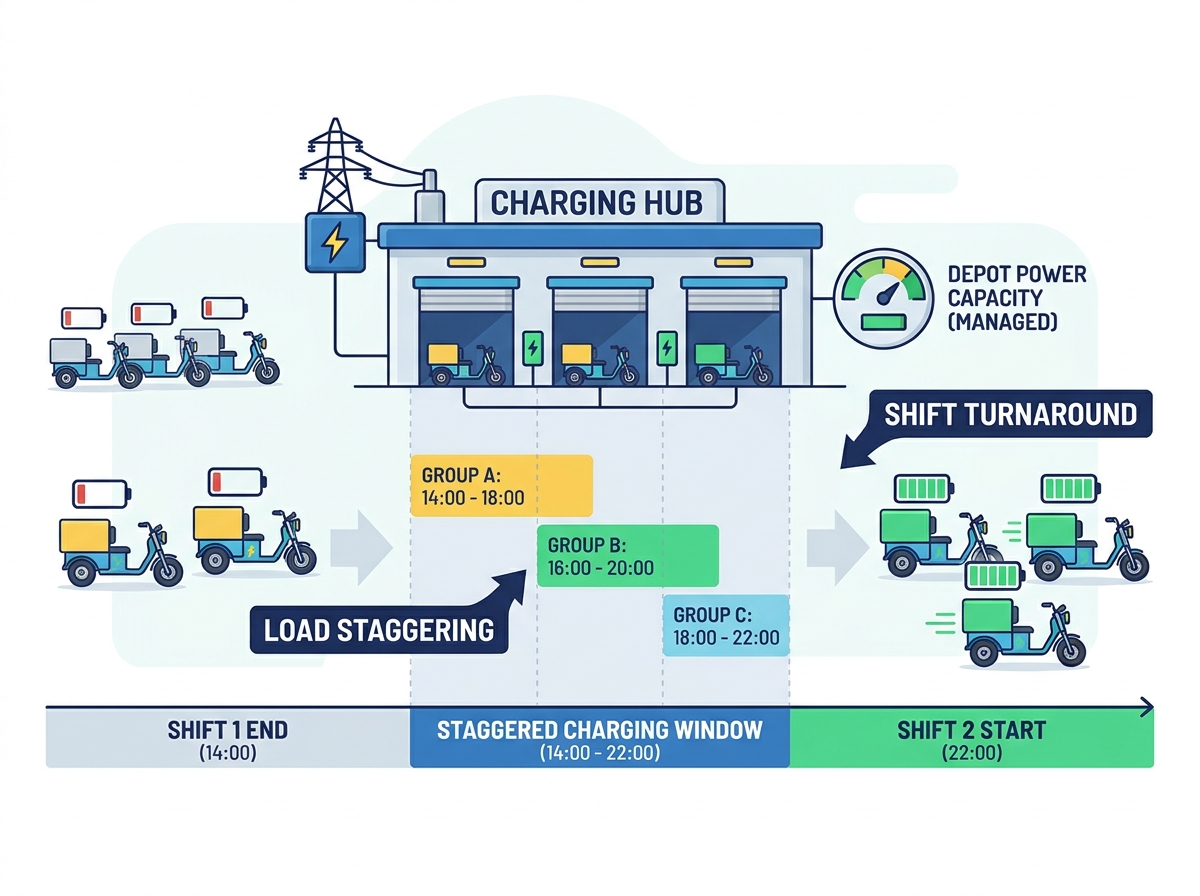
The primary bottleneck in scaling last-mile electric fleets is rarely vehicle acquisition; it is the physical and financial constraint of depot power infrastructure. Unmanaged simultaneous charging of an electric tricycle fleet triggers exorbitant peak demand charges, exceeds existing grid capacity, and risks vehicle downtime during critical shift turnarounds. Establishing a data-driven charging strategy bridges the gap between operational duty cycles and facility energy limits. This guide breaks down how to architect an electric tricycle depot charging schedule that prioritizes load staggering, ensures shift readiness, and prevents costly electrical infrastructure upgrades. We will examine practical methods to map route energy consumption, align multi-shift turnarounds, and deploy charge management software. By controlling when and how fast each vehicle draws power, operators can maximize fleet availability without overtaxing the local grid.
Key Takeaways
Capacity Constraints Dictate Strategy: Aligning your fleet charging schedule with your baseline depot power capacity prevents the need for six-figure grid upgrades and transformer replacements.
Duty Schedules vs. Charging Schedules: Operational route planning must dictate charging windows. An effective schedule guarantees the required State of Charge (SoC) for the next shift without over-allocating power.
Load Staggering Reduces Opex: Shifting energy consumption to off-peak hours and smoothing peak loads can reduce energy costs by up to 50% while maintaining fleet availability.
Fewer Chargers Required: An optimized schedule allows depots to safely increase their vehicle-to-charger ratio, drastically reducing upfront hardware investments.
Software is Mandatory for Scale: Manual plug-in schedules fail due to human error. Automated Load Management Systems (LMS) are required to dynamically balance power distribution across electric cargo tricycles.
The Financial and Operational Case for a Managed Fleet Charging Schedule
Defining the Baseline Depot Power Capacity
Before deploying a single vehicle, fleet operators must establish the absolute limits of their facility's electrical infrastructure. Conducting a comprehensive facility energy audit is the first step in determining the available kilowatt (kW) overhead. This involves analyzing historical utility bills and measuring the peak draw of existing building operations, such as high-bay lighting, HVAC systems, and automated sorting conveyors. The difference between the facility's peak historical load and the maximum continuous rating of the main electrical panel represents the usable capacity for vehicle charging.
Introducing a high-density fleet without understanding these limits immediately threatens site stability. Existing switchgears and transformers have hard physical constraints dictated by electrical codes, which typically limit continuous loads to 80% of the breaker rating. When the combined draw of facility operations and fleet charging exceeds these ratings, the hardware will fail or trip protective breakers. By accurately mapping your depot power capacity, you establish the mathematical ceiling that your charging schedule must never breach.
Infrastructure Component
Load Type
Peak Draw (kW)
Impact on Charging Capacity
Main Switchgear
Facility Total
800 kW (Rated)
Sets the absolute maximum limit for the entire site.
HVAC & Lighting
Continuous / Variable
150 kW
Reduces available overhead during daytime operations.
Sorting Conveyors
Intermittent Peak
200 kW
Creates unpredictable spikes that software must navigate.
Available for EVSE
Managed Load
450 kW
The maximum allowable draw for the fleet charging schedule.
The Cost of Unmanaged "Plug-and-Play" Charging
Allowing drivers to plug in their vehicles immediately upon returning to the depot creates a massive, simultaneous spike in energy demand. Utility companies heavily penalize these high-load events through peak demand charges. These charges are calculated based on the single highest 15-minute interval of power consumption during a billing cycle. A fleet of fifty tricycles charging simultaneously at 3 kW each creates a 150 kW spike, which multiplies the monthly utility bill regardless of the total energy consumed.
Beyond utility penalties, unmanaged charging introduces severe operational risks. If the simultaneous load trips a main breaker, the entire depot loses power. This halts sorting operations, disables security systems, and stops all charging activity. When the next shift arrives, drivers face a fleet of dead vehicles, leading to missed delivery windows, breached service level agreements, and cascading logistical failures.
Capital Expenditure (CapEx) Avoidance and Economic Modeling
When faced with a power deficit, the traditional approach is to request a grid upgrade from the local utility. This involves trenching new lines, upgrading transformers, and replacing switchgears. This process takes months and requires massive capital expenditure. Implementing smart scheduling software offers a viable alternative, allowing fleets to operate within existing constraints by intelligently distributing power over time.
Some operators consider installing a Battery Energy Storage System (BESS) to supplement grid power during peak times. While effective, a BESS requires significant upfront investment, dedicated yard space, and ongoing maintenance. In many cases, a rigorous schedule eliminates the need for a BESS entirely. By shifting charging to off-peak hours and throttling charge rates, fleets stay below grid limits without supplemental hardware. Economic modeling consistently shows that software-based load management achieves rapid payback through immediate hardware savings and sustained utility price reductions.
Aligning Duty Cycles with Electric Cargo Tricycle Turnarounds
Mapping Route Energy Consumption
A precise charging schedule relies on accurate energy consumption data. Fleet managers must calculate the exact kilowatt-hours (kWh) required for each specific route. This calculation cannot rely on generic manufacturer range estimates. It must factor in real-world variables that directly impact battery drain.
Payload Weight: A tricycle carrying a maximum capacity load requires significantly more torque and energy to accelerate than an empty vehicle.
Topography: Routes with frequent elevation changes or steep inclines drain batteries faster than flat urban grids.
Stop-and-Go Frequency: Dense urban delivery routes with constant stopping and starting consume more power than continuous driving.
Operators must abandon the fallacy that every vehicle requires a 100% charge before dispatch. Optimizing for the necessary State of Charge (SoC) plus a strict 15-20% safety buffer drastically reduces the required plug-in time. If a route only consumes 40% of the battery capacity, charging the vehicle to 100% wastes valuable time and power allocation that could be directed to a vehicle assigned to a longer, more demanding route.
Multi-Shift Turnaround Windows and Charger Ratios
Logistics operations running multiple shifts face tight turnaround windows. The time available between driver shifts must be weighed against the maximum charge rate of the vehicles. For high-utilization fleets operating 16 to 24 hours a day, the critical charging window is often limited to a brief 45 to 90-minute period during shift handoffs or sorting phases.
Understanding these time constraints is vital for optimizing the charger-to-vehicle ratio. A 1:1 ratio is an inefficient use of capital and physical space. By staggering dispatch times and utilizing a well-planned fleet charging schedule, operators can support multiple vehicles with a single charging station. As one vehicle finishes its required charge and departs, the next vehicle rotates in, maximizing the utilization of each physical charger and reducing overall hardware requirements.
Prioritization Algorithms for Fleet Readiness
Manual, first-in, first-out (FIFO) charging is inadequate for complex logistics. If a vehicle returning at 14:00 is not needed until 08:00 the next day, it should not immediately draw maximum power while a vehicle needed for a 16:00 dispatch sits waiting. Automated prioritization algorithms solve this by ranking vehicles based on two critical data points: next-departure time and current SoC.
The software dynamically allocates power to the vehicles with the most urgent operational needs. It calculates the energy deficit (Target SoC minus Current SoC) and divides it by the remaining dwell time to determine the minimum required charge rate. Once priority vehicles reach their target SoC, the system automatically redirects power to the next tier of vehicles. This ensures the fleet is always ready for the immediate upcoming shift without exceeding the facility's maximum power threshold.
Core Strategies for Load Staggering in an Electric Tricycle Depot
Sequential Charging vs. Simultaneous Throttling
When managing power distribution across a fleet, operators generally choose between two primary load management strategies: sequential charging and simultaneous throttling. Each approach has distinct operational impacts and hardware requirements.
Sequential charging delivers maximum available power to a specific subset of vehicles until they reach their target SoC, then switches the power feed to the next batch. This ensures rapid turnaround for individual vehicles but requires complex switching hardware to physically route the current. Simultaneous throttling, or active load management, distributes the available power equally or proportionally across all plugged-in vehicles. While this results in slower overall charge times per vehicle, it utilizes simpler hardware and provides a highly stable, predictable draw on the grid.
Strategy
Mechanism
Primary Advantage
Primary Disadvantage
Sequential Charging
Charges vehicles in batches at full power, switching sequentially.
Faster individual vehicle turnaround times.
Requires advanced switching hardware and precise physical rotation.
Simultaneous Throttling
Distributes available kW proportionally across all connected vehicles.
Simpler infrastructure; highly effective at protecting grid limits.
Slower overall charge duration for each individual vehicle.
Hybrid Prioritization
Throttles non-essential vehicles while giving full power to urgent dispatches.
Balances grid protection with immediate operational readiness.
Requires advanced API integration with routing software.
Time-of-Use (TOU) Tariff Optimization
Utility companies structure their billing using Time-of-Use (TOU) tariffs, where electricity is significantly more expensive during peak daylight and early evening hours. A sophisticated charging schedule maps these utility rate structures against the fleet's downtime. The goal is to shift as much energy consumption as possible into the cheapest overnight billing windows.
Software can delay charge initiation even if a vehicle is plugged in at 17:00. The system holds the vehicle in a standby state until off-peak pricing begins at 22:00, then initiates the charge. This strategy requires precise calculation to ensure the delayed start does not jeopardize morning dispatch readiness. The software continuously recalculates the required charge time against the remaining off-peak window, overriding the delay if a vehicle needs more time to reach its target SoC.
Peak Shaving and Load Smoothing
Peak shaving involves flattening the depot's energy consumption curve to prevent sudden spikes in demand. Instead of allowing chargers to draw maximum power immediately upon connection, the system artificially caps the draw at a predetermined site-level limit. This maintains a predictable, low-variance load profile throughout the night.
Load smoothing works in tandem with peak shaving by filling in the valleys of energy consumption. If facility operations shut down at midnight, the load management system detects the drop in building power usage through a local meter integration. It then automatically increases the power allocated to the chargers. This dynamic adjustment ensures the facility utilizes its maximum allowable capacity efficiently without ever crossing the penalty threshold.
Hardware, Software, and Physical Infrastructure Requirements
Selecting the Right EVSE (Electric Vehicle Supply Equipment)
Choosing the correct charging hardware is critical for executing a managed schedule. For an electric tricycle, battery capacities are relatively small compared to full-sized electric vans or box trucks. Consequently, expensive DC Fast Charging infrastructure is rarely economically viable or operationally necessary. AC Level 2 chargers, typically ranging from 3.3 kW to 7.2 kW, provide sufficient power to fully recharge these vehicles within standard overnight or intra-shift windows.
The absolute requirement is that the EVSE must be networked and OCPP-compliant (Open Charge Point Protocol). Non-networked chargers cannot receive dynamic load commands or report energy usage. OCPP 1.6J or 2.0.1 compliance ensures the hardware communicates seamlessly with third-party software, allowing the system to throttle power, delay charging, and monitor session data in real-time.
Physical Depot Layout and Safety Considerations
The physical layout of the charging stations directly impacts the efficiency of multi-shift handoffs. Chargers must be positioned to facilitate smooth traffic flow, preventing bottlenecks when dozens of drivers return simultaneously. Pull-through charging bays or angled parking designs reduce reversing maneuvers and speed up the rotation process.
Protecting the infrastructure is equally important. Installing heavy-duty steel bollards around the EVSE prevents accidental collisions from tricycles or forklifts. Cable management systems, such as overhead retractors, keep cords off the ground to prevent tripping hazards and cable degradation. For indoor charging areas, operators must ensure proper ventilation. While an electric cargo tricycle produces no tailpipe emissions, the charging process generates heat. Adequate airflow prevents localized temperature spikes that degrade charger performance or trigger thermal safety shutdowns.
Charge Management Software (CMS) Integration
The Charge Management Software (CMS) acts as the brain of the operation, automatically executing the charging schedule without human intervention. It continuously monitors grid capacity, TOU rates, and vehicle SoC, adjusting power distribution second by second based on predefined rules.
To maximize efficiency, the CMS must integrate with existing fleet management and routing software via robust APIs. This integration allows the routing software to push tomorrow's dispatch schedule and required kWh directly to the CMS. The CMS then builds a custom charging profile for the night, ensuring every vehicle receives exactly the energy it needs based on its specific assigned route.
Telematics and SoC Monitoring
A dynamic schedule requires real-time vehicle data. Telematics systems extract CAN bus data to transmit the current SoC, battery health, and location of each tricycle back to the central dashboard. This data informs the prioritization algorithms, ensuring vehicles with the lowest batteries and earliest dispatch times receive power first.
Handling vehicles that do not transmit SoC data directly to the charger presents a challenge. In these cases, operators must rely on predictive energy modeling. By analyzing historical route data, payload weights, and distance traveled, the software estimates the returning vehicle's SoC and allocates power accordingly. The system applies a slightly larger safety buffer to account for the lack of real-time telemetry, ensuring the vehicle still meets its dispatch requirements.
Implementation Risks and Mitigation Strategies
Operator Compliance and Plug-in Discipline
The most sophisticated software cannot charge a vehicle that is not physically connected. Driver non-compliance—failing to plug in vehicles or plugging into the wrong designated chargers at the end of a long shift—is a primary point of failure in depot operations.
Mitigating this risk requires strict Standard Operating Procedures (SOPs). Depots should implement the following steps:
Utilize visual indicators, such as large LED status lights above each bay, to confirm a successful connection.
Assign specific charging bays to specific routes to eliminate driver confusion during parking.
Configure the CMS to send automated SMS or dashboard alerts to shift supervisors if a scheduled vehicle remains unplugged 15 minutes after its designated return time.
Conduct weekly audits of plug-in compliance rates and retrain drivers who consistently miss the protocol.
Hardware Failures and Redundancy Planning
Relying entirely on cloud-based scheduling introduces vulnerability to network outages. If the depot loses internet connectivity, the CMS cannot send dynamic load commands. This potentially halts the overnight charge or causes chargers to default to maximum power and trip breakers.
Enterprise-grade chargers must feature local failover modes. In the event of a network drop, the hardware automatically reverts to a pre-set, safe power limit (e.g., 1.5 kW per charger) stored in the local controller. This guarantees vehicles continue to charge slowly without exceeding the facility's hard capacity limits. Additionally, operators should maintain a 10-15% charger redundancy ratio to ensure operations continue smoothly if individual cables or units require maintenance.
Battery Degradation Considerations
Aggressive charging profiles, particularly pushing maximum current into the battery to meet tight turnaround times, accelerate lithium-ion battery wear. High C-rates generate excess heat, degrading the internal cell chemistry over time and reducing the vehicle's effective range.
Smart scheduling mitigates this by stretching the charge duration whenever possible. If a vehicle has an eight-hour dwell time, the software throttles the power to deliver a slow, steady charge at a lower C-rate (e.g., below 0.5C), rather than blasting the battery at full power for two hours and letting it sit idle. This gentle charging profile significantly extends battery lifespan and maintains fleet reliability over years of operation.
Conclusion
An optimized charging schedule is a mandatory requirement for scaling a fleet within the physical limits of commercial real estate. By aligning duty cycles with intelligent power distribution, operators avoid massive infrastructure costs, bypass utility penalties, and guarantee shift readiness. Prioritize OCPP-compliant hardware and software vendors that offer dynamic load management, API integrations with routing tools, and local failover capabilities.
To begin implementing a resilient charging strategy, execute the following steps:
Commission a facility energy audit to determine baseline depot power capacity and identify peak facility loads.
Pull historical telematics data to map exact kWh requirements per route based on payload and topography.
Establish a strict minimum SoC threshold for dispatch to eliminate unnecessary 100% charging cycles.
Run a simulated charging schedule pilot on a small subset of the fleet before full-scale hardware procurement.
FAQ
Q: What is the difference between a duty schedule and a fleet charging schedule?
A: A duty schedule dictates when a vehicle is on the road, its route, and driver assignment. A charging schedule dictates exactly when, how fast, and to what level the vehicle receives power while at the depot to meet the duty schedule's requirements without exceeding facility power limits.
Q: How does load staggering reduce charging costs for an electric tricycle fleet?
A: Load staggering prevents all vehicles from drawing maximum power simultaneously. This avoids utility peak demand charges and allows the depot to shift energy consumption to cheaper, off-peak Time-of-Use (TOU) billing hours, often reducing overall energy costs by up to 50%.
Q: Can I charge an electric cargo tricycle fleet without upgrading my depot power capacity?
A: Yes, in many cases. By utilizing smart charging software to throttle charge rates and stagger sessions, fleets can stay below the facility's existing electrical panel limits, avoiding expensive grid upgrades or the immediate need for supplemental battery storage.
Q: What happens if the depot loses internet connection during a scheduled charge?
A: Enterprise-grade charging hardware features a local failover mode. If the cloud connection drops, the chargers automatically revert to a pre-set, safe power limit stored on the local controller to ensure vehicles still charge without tripping facility breakers or exceeding grid capacity.
Q: Do I need DC Fast Chargers for an electric tricycle depot?
A: Rarely. Because electric tricycles have relatively small battery capacities compared to electric trucks or buses, AC Level 2 charging is typically sufficient to fully recharge a vehicle within a standard shift turnaround window, at a fraction of the hardware and installation cost.
Q: How do I handle charging for multi-shift electric tricycle operations?
A: Multi-shift operations require aggressive turnaround management and efficient physical depot layouts. The schedule must prioritize vehicles needed for the immediate next shift, utilizing dynamic load management to direct maximum available power to those specific tricycles while delaying others.
Beneath the Tianshan Mountains in June, sweet fruits fill the air and bustling business exchanges thrive. On June 25, 2026, the 9th China-Eurasia Expo grandly kicked off in Urumqi, Xinjiang. As an influential comprehensive international event along the Belt and Road Initiative, this year’s expo hit
From May 26 to 29, the highly anticipated "Comprehensive Upgrade, Leading the Future with Intelligence" JP Group 2026 Business Summit & New Product Launch grandly kicked off at Xiamen International Expo Center.