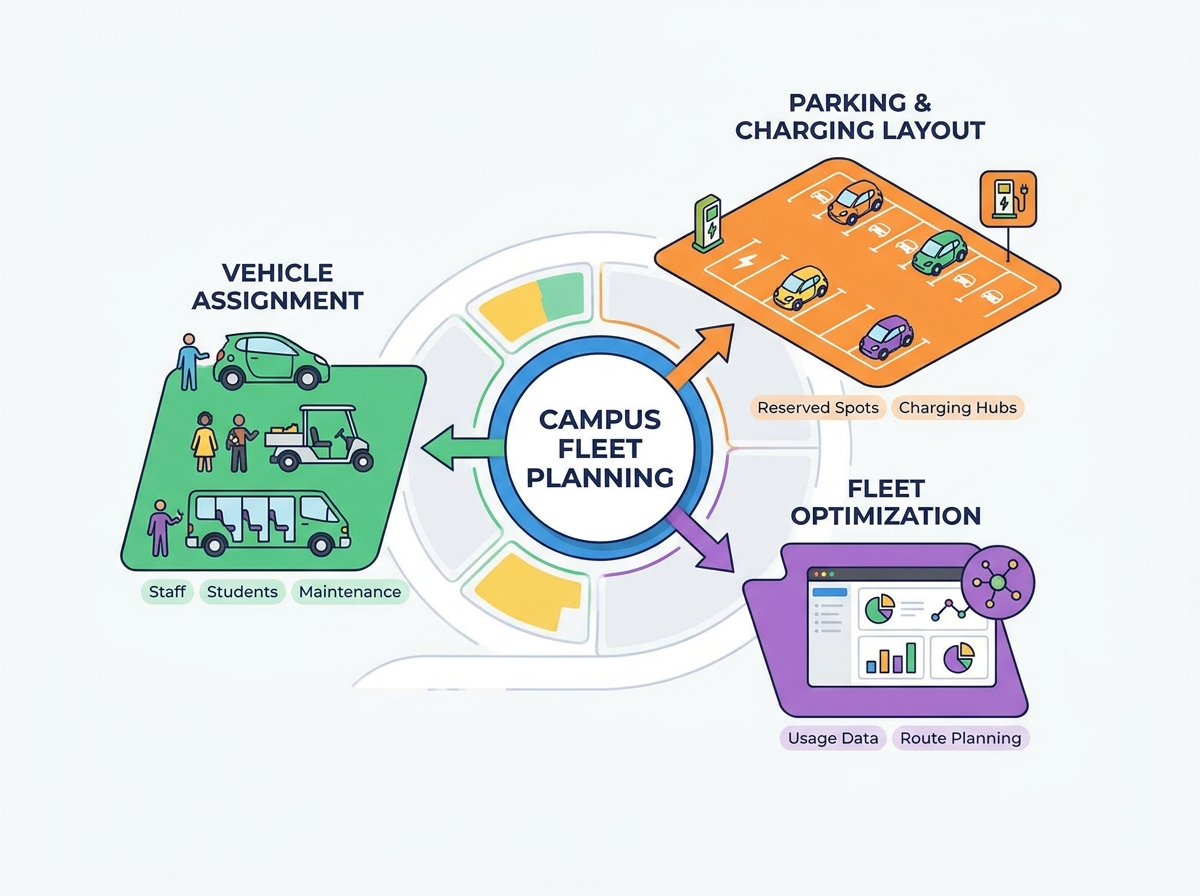
Transitioning from gas-powered utility carts to electrified fleets on large-scale properties like universities, corporate headquarters, and logistics parks is accelerating. Ad-hoc procurement creates stranded assets and grid overloads. Facilities managers struggle to balance vehicle parking realities with the technical demands of scalable charging infrastructure. They often apply standard passenger-vehicle assumptions to specialized utility fleets, causing severe operational friction. Effective low speed electric car campus fleet planning requires a systems-engineering approach. You cannot simply swap old vehicles for new ones. This guide provides a technical framework for evaluating vehicle assignment, designing space-efficient parking layouts, and deploying resilient charging infrastructure that aligns with operational duty cycles and site scale.
Align Procurement with Duty Cycles: Prevent over-specification by matching vehicle payload and battery capacities to precise campus tasks, site scale, and shift durations.
Optimize Spatial Footprints: Leverage the reduced dimensions of a low speed electric car to design high-density parking layouts and modified curbside spaces that free up premium campus real estate.
Decentralize and Segregate Charging Infrastructure: Deploy a mix of Level 1 and Level 2 charging stations based on vehicle dwell times, utilizing networked load management and strictly separating fleet charging from public/student infrastructure.
Mitigate Operational Bottlenecks: Establish strict interface rules for shift peaks, maintenance protocols, and safety visibility to ensure high fleet availability and minimize adoption friction.
Framing the Campus Fleet Problem: Success Criteria and Operational Baselines
Campus environments present unique mobility challenges. You must define the exact scope of your fleet before drafting procurement documents. Distinguish between Neighborhood Electric Vehicles (NEVs), Low-Speed Vehicles (LSVs), and basic industrial utility carts. Federal classifications, specifically FMVSS 500, dictate safety requirements for street-legal operation. These regulations mandate specific features like DOT-approved windshields, three-point seatbelts, backup cameras, and turn signals. If your routes cross public municipal roads intersecting the campus, compliance is non-negotiable. Industrial carts work well for closed-loop groundskeeping, but they fail compliance tests for mixed-traffic transit.
Legacy planning methodologies consistently fail modern electrified fleets. Treating EV fleet planning as a simple one-to-one replacement for internal combustion vehicles is a massive error. Gas vehicles refuel in minutes at a centralized pump. Electric vehicles require dedicated dwell times and distributed infrastructure. Applying gas-fleet logic to EVs leads to charging queues at the end of shifts. It results in underutilized vehicles sitting idle. Spatial inefficiencies multiply when standard parking spaces house compact carts. Furthermore, plugging dozens of vehicles into unmanaged circuits overloads electrical panels. A common failure occurs when a facility replaces 30 gas carts with 30 EVs and plugs them all into standard 120V wall outlets on a single 200-amp breaker panel at 5 PM. The breaker trips immediately. The next morning, zero carts are charged.
You must establish measurable success criteria early in the planning phase. Target specific reductions in Scope 1 emissions. Track operational uptime across diverse campus environments. A successful deployment maintains or improves the daily productivity of your staff. If groundskeepers spend more time managing charging cables than maintaining the landscape, the deployment has failed. Define baseline metrics for daily mileage, payload frequency, and maintenance downtime before introducing new vehicles.
Vehicle Assignment Strategies for Electric Mini Car Fleets
Procuring an electric mini car fleet demands rigorous duty cycle analysis. You must audit current vehicle usage meticulously. Map the daily mileage of every existing cart. Document payload requirements accurately. Distinguish between light passenger transport and heavy groundskeeping tasks. A security patrol vehicle runs 40 miles per shift, mostly on paved roads. A groundskeeping cart runs 12 miles but hauls 1,500 pounds of wet mulch across soft turf. These require completely different drivetrains and suspension setups. Track idle times to identify opportunities for shared usage. Over-purchasing battery capacity adds unnecessary weight to the vehicle and wastes resources.
Campus topography and site scale dictate technical specifications. A sprawling logistics park demands different hardware than a compact, pedestrian-heavy university. Elevation changes heavily influence motor torque requirements. Steep inclines drain batteries faster and require robust braking systems, such as four-wheel hydraulic disc brakes. Climate conditions also dictate battery chemistry choices. Lead-acid batteries struggle in freezing temperatures, require regular distilled water maintenance, and degrade quickly if left uncharged. Lithium-ion batteries offer superior cold-weather performance and zero daily maintenance. They do require sophisticated battery management systems (BMS) to monitor cell health and prevent thermal runaway.
Operational Application
Recommended Payload Capacity
Ideal Battery Chemistry
Motor Torque Requirement
Suspension Type
Security Patrol
500 - 800 lbs
Lithium-Ion (Fast Charge)
Standard (AC Motor)
Independent Front Suspension
Groundskeeping / Landscaping
1,500 - 2,000 lbs
Lithium-Ion (High Capacity)
High Torque (Geared)
Heavy-Duty Leaf Springs
Executive / VIP Transport
800 - 1,200 lbs
Lead-Acid or Lithium-Ion
Standard (AC Motor)
Coil-Over Shocks (Comfort)
Rethink your allocation models. Traditionally, facilities assign vehicles to specific departments. This creates silos where some vehicles sit idle for days while other departments face shortages. Compare this to a centralized, telematics-driven pooled fleet model. Pooling reduces the overall vehicle count. It maximizes utilization rates across the board. Staff check out vehicles based on immediate task requirements rather than departmental ownership.
Develop a strict procurement feature checklist. Do not accept off-the-shelf consumer models for heavy commercial use. Demand programmable speed limiters to enforce campus safety protocols. Require onboard diagnostics for predictive maintenance. Specify modular cargo beds tailored to specific operational silos. A modular bed can switch from a flatbed for lumber to a secure utility box for electrical tools within minutes.
Spatial Planning: Parking Layouts for Low Speed Electric Cars
The dimensional differences between standard passenger vehicles and a low speed electric car offer massive spatial optimization opportunities. Standard parking spaces consume roughly 160 to 180 square feet. LSVs require a fraction of that footprint. By restriping dedicated fleet zones, you can double or triple your lot yield. This reclaims premium campus real estate for other operational needs.
Vehicle Type
Average Length
Average Width
Required Parking Space Size
Spaces per 1,000 Sq Ft
Standard Passenger Truck/SUV
18 - 20 feet
6.5 - 7 feet
9' x 18' (162 sq ft)
Approx. 6 spaces
Compact Passenger Car
14 - 15 feet
5.5 - 6 feet
8' x 16' (128 sq ft)
Approx. 7-8 spaces
Low-Speed Vehicle (LSV)
8 - 10 feet
4 - 4.5 feet
5' x 12' (60 sq ft)
Approx. 16 spaces
Curbside and off-street adaptations require different architectural strategies. Modifying curbside parallel parking spaces allows for perpendicular LSV parking. Because an LSV is often shorter than the width of a standard parallel space, you can park three LSVs nose-in where one passenger car would normally park parallel to the curb. For off-street fleet depots, design high-density herringbone or straight-in layouts that minimize driving lane widths. A standard parking lot requires 24-foot drive aisles for two-way traffic. An LSV-only depot functions efficiently with 14-foot drive aisles due to the significantly tighter turning radius of the vehicles.
Strategic siting determines fleet efficiency. Evaluate the trade-offs between a centralized hub and distributed zones. A single large-scale fleet depot simplifies charging infrastructure installation and maintenance oversight. However, it forces staff to walk long distances to retrieve vehicles. Micro-parking zones adjacent to high-demand operational buildings improve dispatch times. Distributed zones require more complex electrical trenching but drastically reduce daily operational friction.
Navigating ADA compliance and pedestrian right-of-ways is critical. Integrating LSV parking into mixed-use campus environments poses safety risks if poorly executed. You must not obstruct pedestrian pathways or wheelchair ramps. Ensure charging cables do not cross sidewalks, creating trip hazards. Design parking zones with clear lines of sight to prevent blind spots when vehicles back out into pedestrian-heavy corridors. Maintain a maximum 2% cross slope in all designated parking areas to comply with accessibility standards.
Measure the exact footprint of the largest vehicle in the proposed fleet.
Calculate the required turning radius for safe ingress and egress.
Restripe existing standard spaces into micro-bays, maintaining a minimum of 36 inches between vehicles for safe operator access.
Install physical wheel stops to prevent vehicles from encroaching on pedestrian walkways or charging pedestals.
Route all electrical conduit underground before pouring new asphalt or concrete pads.
Designing the Charging Infrastructure Layout
Selecting the right charging speed for campus electric vehicles prevents wasteful infrastructure spending. Create a decision matrix based on battery capacity and operational dwell times. Level 1 charging utilizes standard 120V, 15-20 amp circuits. It is often sufficient for vehicles that park overnight for 10 to 12 hours. It requires minimal electrical upgrades and utilizes standard NEMA 5-15 or 5-20 receptacles. Level 2 charging utilizes 240V, 30-50 amp circuits. It is necessary for high-utilization vehicles that require mid-shift opportunity charging. Reserve Level 2 stations for security patrols or multi-shift logistics carts.
Charging Level
Voltage / Amperage
Typical Charge Time (0-100%)
Best Use Case
Infrastructure Requirement
Level 1
120V / 15-20A
8 - 12 Hours
Overnight charging, single-shift vehicles
Standard NEMA 5-15/5-20 receptacles
Level 2
240V / 30-50A
3 - 5 Hours
Multi-shift vehicles, rapid opportunity charging
Dedicated 240V circuits, NEMA 14-50 or hardwired
Segregating fleet charging from public or student charging is an absolute necessity. Fleet vehicles are critical operational assets. They cannot wait in line behind a student's personal EV. Physically separate dedicated fleet charging hubs using fencing or restricted access gates. Digitally separate them using RFID cards or telematics-based access controls. This guarantees fleet uptime and prevents unauthorized power theft.
Electrical load management prevents catastrophic grid overloads. Conduct a comprehensive site energy audit before installing hardware. Evaluate existing panel capacities at proposed parking zones. Implement smart-charging software to stagger charging loads. If fifty vehicles plug in simultaneously at 5:00 PM, peak demand spikes will trigger facility-wide power issues. Smart software delays charging for certain vehicles until midnight, smoothing the electrical draw and protecting facility infrastructure.
Map the networked pathways and user interfaces clearly. The physical and digital journey of a vehicle from a low battery alert to a designated charging station must be frictionless. Install clear, highly visible signage directing drivers to available ports. Implement overhead cable management systems, such as retractable tool balancers, to keep heavy cords off the ground. Establish strict driver plug-in protocols and hold operators accountable through telematics reporting if vehicles are left uncharged.
Evaluating Operational Value and Infrastructure Scalability
Long-term operational value relies heavily on infrastructure scalability and maintenance readiness. Upgrading existing maintenance bays is a mandatory step when transitioning to an electrified fleet. You must retrofit these facilities to safely service high-voltage systems. This includes installing specialized two-post lifts designed for the unique weight distribution of battery-heavy utility carts. If you operate lead-acid fleets, you must upgrade HVAC ventilation systems to safely extract hydrogen gas emitted during the charging process. For lithium-ion fleets, install Class D fire suppression systems and establish dedicated quarantine zones for damaged battery packs.
Future-proofing your site design ensures seamless fleet expansion. Install make-ready infrastructure during the initial construction phase. Laying 3-inch underground conduit instead of 1-inch conduit requires the same amount of trenching labor but allows you to pull thicker gauge wire later when adding more charging stations. Oversize your electrical subpanels to accommodate future breaker additions. This proactive approach prevents tearing up fresh asphalt when the fleet inevitably grows.
Software and telematics integration drive operational efficiency. Modern fleet management software monitors battery health at the cellular level, tracks vehicle locations in real-time, and optimizes charging schedules. Telematics data allows facilities managers to identify underutilized vehicles and reassign them to high-demand zones. This data-driven approach extends battery lifespans by preventing deep discharges and ensures maximum uptime across the entire campus network.
Implementation Risks and Mitigation Frameworks
Managing shift peaks and charging bottlenecks requires proactive scheduling. The greatest risk to fleet availability occurs when all operators return vehicles simultaneously. If charging ports are limited, a bottleneck forms instantly. Propose staggered shift schedules to spread the return times. Implement opportunity charging windows during lunch breaks. Enforce strict plug-in compliance rules. A vehicle parked without being plugged in disrupts the entire next shift.
Safety and visibility in mixed-traffic zones demand hardware upgrades. Operating low-profile vehicles for short distance EV transport poses severe risks in logistics parks alongside heavy freight trucks. They are equally risky in dense pedestrian zones where quiet electric motors go unnoticed. Equip all fleet vehicles with high-visibility strobe lighting and reflective decaling. Install Acoustic Vehicle Alerting Systems (AVAS) to emit artificial sounds at low speeds, warning pedestrians of approaching vehicles. Designate specific transit corridors strictly for LSV use to separate them from heavy commercial traffic.
Weather resilience directly impacts battery degradation. Operating and charging in extreme temperatures degrades lithium-ion and lead-acid batteries rapidly. Direct sunlight bakes dashboard electronics and overheats charging components. Construct structural canopies over outdoor charging zones to provide shade and rain protection. Specify vehicles with active thermal management systems if operating in freezing climates. Establish proper seasonal battery storage protocols for vehicles that sit idle during winter or summer breaks.
Regulatory compliance and zoning laws dictate where any electric car or utility vehicle can operate. You must navigate local municipal road-use restrictions carefully. A campus often intersects with city-owned streets. Ensure your vehicles meet all street-legal requirements if they cross these boundaries. Consult campus-specific fire codes regarding lithium-ion battery charging. Some jurisdictions require specialized fire suppression systems or minimum setback distances from occupied buildings when installing high-density charging hubs.
Conclusion
Successful campus fleet electrification is an infrastructure project, not just a vehicle procurement exercise. You must treat the vehicles, the parking layouts, and the charging hardware as a single, integrated ecosystem. Ignoring any one of these pillars guarantees operational bottlenecks. Facilities managers must shift their perspective from buying carts to engineering mobility networks.
When evaluating vendors, prioritize consultative partners over simple equipment dealers. Look for manufacturers who offer comprehensive site planning and modular charging hardware. Select right-sized vehicles tailored to your specific campus duty cycles. Avoid off-the-shelf consumer models that lack the durability and telematics required for commercial fleet management.
Take immediate action before issuing your next RFP. Follow these precise steps to ensure a successful rollout:
Conduct a 30-day telematics audit of your existing gas or basic electric fleet to establish accurate, data-driven duty cycles.
Commission a preliminary electrical load study for all proposed parking zones to identify panel upgrade requirements early.
Define clear physical and digital boundaries between fleet charging assets and public or student charging stations.
Draft a strict operator compliance manual detailing plug-in responsibilities and safety protocols for mixed-traffic zones.
FAQ
Q: What is the standard parking space size for a low speed electric car?
A: A standard passenger vehicle space is typically 9 by 18 feet. A low speed electric car requires only about 5 by 12 feet. This drastically reduced footprint allows facilities to park up to three LSVs in a modified curbside parallel space or double the capacity of off-street fleet depots, maximizing overall lot yield.
Q: Do campus electric vehicles require Level 2 charging stations?
A: Not always. If vehicles have long overnight dwell times of 10 to 12 hours, standard Level 1 charging is usually sufficient and avoids costly electrical upgrades. Level 2 charging should be reserved for high-utilization vehicles that run multiple shifts and require rapid opportunity charging during the day.
Q: Should we allow staff and students to use the fleet charging stations?
A: No. You must strongly advise against shared charging infrastructure. Fleet vehicles are critical operational assets that require guaranteed access to power. Allowing public use creates charging queues and downtime. Recommend physically segregated and access-controlled charging zones strictly dedicated to fleet operations.
Q: How do you calculate the charging load for an electric mini car fleet?
A: Multiply the total vehicle count by the onboard charger capacity in kilowatts, then factor in the available charging window hours. To prevent peak demand spikes, utilize load-balancing software. This software distributes the available electrical capacity dynamically, ensuring all vehicles charge fully without exceeding the facility's maximum panel limits.
Q: What are the zoning restrictions for short distance EV transport on mixed-use campuses?
A: Zoning restrictions depend on the intersection of federal classifications and local laws. Vehicles classified as LSVs under FMVSS 500 can typically operate on roads with speed limits up to 35 mph. However, local municipal road-use laws may restrict them from crossing specific public intersections cutting through the campus.
Q: How should we handle charging during peak operational shifts?
A: Implement opportunity charging windows during scheduled breaks to top off batteries. Utilize telematics-based load balancing to prioritize charging for vehicles with the lowest state of charge. For extremely heavy duty cycles, consider battery swapping systems or maintaining a small reserve pool of fully charged vehicles.
Beneath the Tianshan Mountains in June, sweet fruits fill the air and bustling business exchanges thrive. On June 25, 2026, the 9th China-Eurasia Expo grandly kicked off in Urumqi, Xinjiang. As an influential comprehensive international event along the Belt and Road Initiative, this year’s expo hit
From May 26 to 29, the highly anticipated "Comprehensive Upgrade, Leading the Future with Intelligence" JP Group 2026 Business Summit & New Product Launch grandly kicked off at Xiamen International Expo Center.