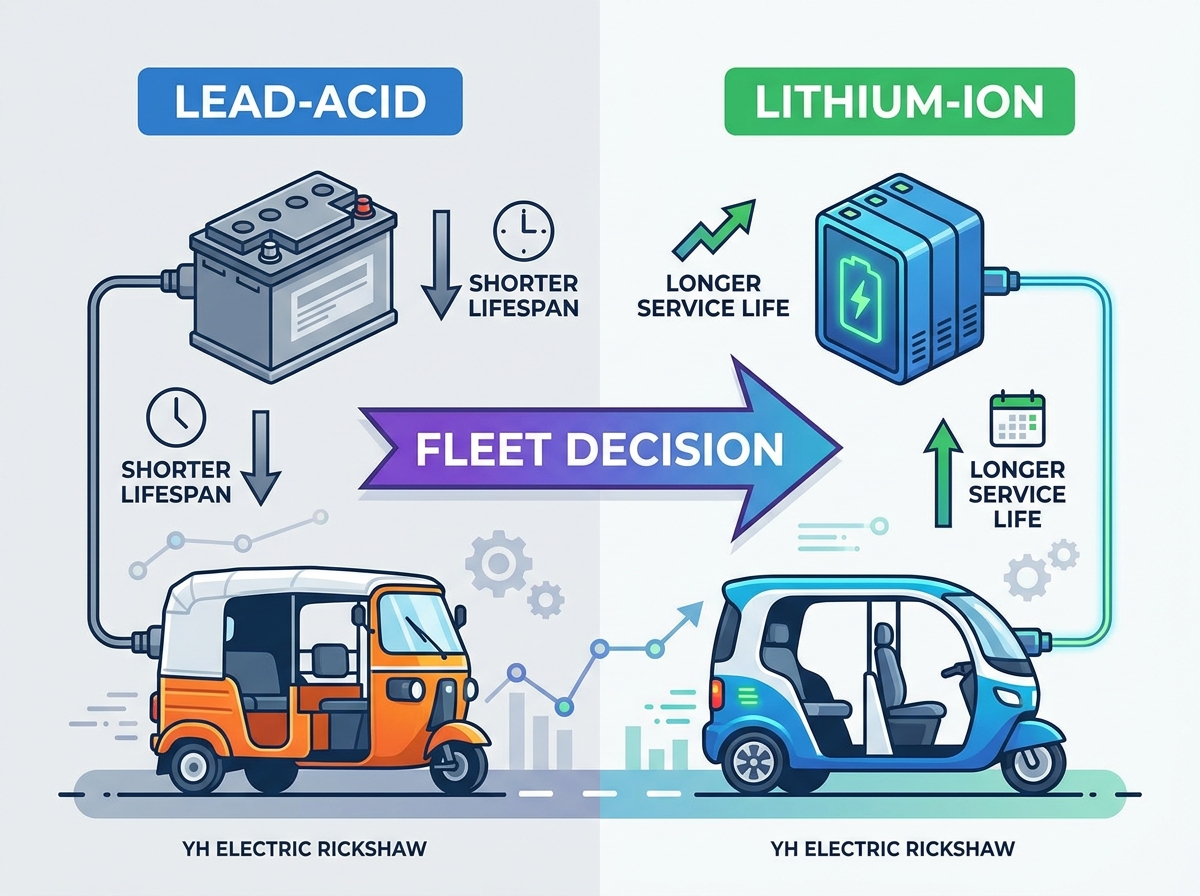
Battery procurement dictates the profitability, uptime, and scaling potential of commercial three-wheeler fleets. The power source acts as the single most critical variable in your operation. Fleet operators face a constant tension. You want to minimize initial capital expenditure using legacy technology. Yet, you must maximize operational efficiency and long-term value with modern alternatives. Choosing the wrong battery chemistry cripples daily revenue. It forces vehicles off the road for extended charging and inflates maintenance labor costs.
This guide provides an objective, metric-driven comparison of lead-acid and lithium battery systems. We evaluate charge times, cycle degradation, weight penalties, and maintenance demands. You will understand the exact operational impacts of each technology to facilitate evidence-based procurement decisions for fleet managers.
Upfront vs. Lifetime Cost: Lead-acid batteries require significantly lower initial investment, but lithium systems yield a demonstrably lower lifetime cost over a 3-to-5-year operational horizon, making them the superior choice for commercial buyers focused on long-term value.
Operational Uptime: Lithium technology reduces charging downtime from 8–12 hours to 1–3 hours (up to 4X faster), making double-shift or continuous fleet operations viable.
Rickshaw Battery Service Life: Lithium variants typically sustain 4–6 years of daily cycling, whereas lead-acid units degrade rapidly, requiring full replacement every 6–12 months.
Infrastructure & Weight: Transitioning to lithium cuts battery weight by 60–70% (improving payload capacity) but necessitates specialized chargers and updated anti-theft protocols.
Framing the Fleet Procurement Problem: Success Criteria
Fleet success depends entirely on vehicle utilization rates. A three-wheeler sitting in a depot generates zero revenue. Battery selection directly influences how long a vehicle operates daily. It dictates how much cargo it can legally carry. It determines the frequency of maintenance interventions. Fleet managers must evaluate battery technology against strict operational success criteria.
Maximizing Daily Range and Uptime
Daily range determines the revenue ceiling for each driver. Battery capacity dictates this range. However, capacity represents only part of the equation. Charge acceptance rates matter just as much. Fast charge acceptance allows vehicles to replenish energy during short breaks. This keeps vehicles on the road longer. Slow charging forces vehicles out of service for entire shifts. Operational uptime requires batteries that support rapid energy recovery without suffering thermal damage. When a driver stops for a forty-five-minute lunch break, the ability to push energy back into the pack changes the entire shift dynamic.
Managing CapEx vs. OpEx
Procurement requires balancing initial outlays against ongoing operational expenses. The initial purchase price of a battery serves merely as the starting point. Ongoing costs accumulate rapidly. You must account for grid electricity consumed during charging. You must factor in the labor required for routine maintenance. Replacement frequency drives up long-term costs. A cheap battery often results in crippling operational expenses. Evaluating the total lifetime expenditure provides the only accurate financial picture. You cannot build a sustainable fleet model if you replace power units every eight months.
Driver Satisfaction and Vehicle Payload
Battery weight drastically alters vehicle dynamics. Heavy power units strain suspension components. They increase drivetrain wear. They also reduce the maximum legal payload. Less payload means fewer passengers or less cargo per trip. This directly reduces per-trip revenue. Furthermore, heavy vehicles handle poorly. They increase driver fatigue over a long shift. Lighter batteries improve acceleration and braking efficiency. They create a better driving experience and higher cargo yields.
Operational Metric
Heavy Battery Impact (Lead-Acid)
Lightweight Battery Impact (Lithium)
Suspension Wear
Accelerated leaf spring sag and bushing failure.
Normal wear patterns, extending component life.
Legal Payload
Reduced by 80-100 kg to offset battery mass.
Maximized, allowing extra cargo or passengers.
Driver Fatigue
High steering effort and sluggish braking.
Nimble handling and responsive stopping power.
Energy Consumption
High draw required to move dead weight.
Lower draw, extending effective daily range.
Core Technology Overview: Lead-Acid vs. Lithium in Electric Rickshaws
Understanding the underlying chemistry is essential for fleet planning. The physical construction of the battery dictates its performance limits. Legacy systems rely on heavy metals and liquid electrolytes. Modern systems utilize lightweight metals and complex electronic management. Each technology presents distinct advantages and severe limitations for commercial deployment.
The Traditional Standard: Tubular vs. Flat Plate Lead-Acid
Lead-acid chemistry relies on lead dioxide plates submerged in sulfuric acid. Discharging creates lead sulfate. Charging reverses this process. However, the physical construction of the plates varies significantly. This construction determines durability on the road.
Flat Plate Construction: Manufacturers build these cheaply. They use flat lead grids pasted with active material. They suffer from rapid shedding. Deep discharges cause the active material to flake off into the bottom of the casing. They have the shortest lifespan in commercial applications.
Tubular Plate Construction: These enclose the active material within porous polyester gauntlets. This prevents shedding during deep discharge cycles. They are heavier and require a larger initial investment than flat plates. They remain the standard choice for legacy electric rickshaws due to better deep-cycle resilience.
Lead-acid remains the default for many independent operators. The barrier to entry sits very low. Replacement units sit on shelves in almost every local market. The recycling infrastructure for lead operates globally with high standardization.
The Modern Alternative: Lithium-Ion (Li-ion) and LiFePO4
Lithium batteries operate by moving lithium ions between an anode and a cathode. Commercial three-wheelers primarily utilize Lithium Iron Phosphate (LiFePO4) chemistry. This specific chemistry trades slight energy density for massive gains in safety and cycle life. LiFePO4 boasts superior thermal stability. It resists thermal runaway even under physical puncture or severe overcharging.
Every lithium pack requires a Battery Management System (BMS). The BMS acts as a dedicated computer monitoring the cells. It performs several critical functions:
Regulates cell health continuously by monitoring voltage levels across the pack.
Balances the charge across individual cells to prevent localized degradation.
Disconnects the circuit immediately if temperatures exceed safe operating thresholds.
Prevents catastrophic failure and guarantees the advertised lifespan of the unit.
Head-to-Head Evaluation Dimensions
Fleet operators must compare these technologies across tangible operational metrics. Theoretical chemistry matters less than practical depot performance. We evaluate the core dimensions that dictate daily profitability.
Charge Time and Shift Viability
Lead-acid batteries demand eight to twelve hours for a complete charge cycle. They require a slow absorption phase to prevent excessive gassing. This confines vehicles to single-shift operations. The vehicle must sit idle overnight. You cannot rush a lead-acid charge without destroying the internal plates.
Lithium systems accept massive charge currents safely. They achieve full capacity in one to three hours. This rapid-charge capability transforms fleet logistics. It enables opportunity charging. Drivers plug in during lunch breaks or shift changes. A short charge recovers a massive percentage of the battery capacity. This facilitates multi-shift, continuous operations without requiring complex battery swapping infrastructure.
Service Life and Cycle Degradation
Cycle life measures how many times a battery can discharge and recharge before losing significant capacity. Tubular lead-acid units typically deliver three hundred to five hundred cycles. In a daily commercial setting, this translates to severe degradation within months. You must replace them frequently to maintain vehicle range.
LiFePO4 chemistry routinely exceeds two thousand cycles at deep discharge levels. This dramatically extends the rickshaw battery service life. A lithium pack amortizes over four to six years of daily use. The financial impact changes your entire business model. Replacing lead-acid units every six to twelve months drains operational capital. A single lithium battery eliminates these recurring replacement costs and the associated vehicle downtime.
Weight Reduction and Payload Efficiency
A standard lead-acid battery bank for a three-wheeler weighs between one hundred and twenty and one hundred and fifty kilograms. This represents massive dead weight. Switching to a lithium pack of equivalent usable capacity cuts this weight by sixty to seventy percent. The lithium pack weighs roughly forty to fifty kilograms.
This weight reduction translates into immediate tangible outcomes. The vehicle consumes less energy to move its own mass. This increases the range per charge. It reduces the mechanical strain on the drivetrain, axles, and leaf springs. Most importantly, it increases the legal payload capacity. Operators transport an additional passenger or heavier cargo without exceeding manufacturer weight limits.
Maintenance Requirements and Labor Costs
Lead-acid batteries generate hidden labor costs. They require constant physical maintenance. Technicians must perform regular distilled water top-offs to replace evaporated electrolyte. Terminals corrode rapidly from acid vapor. They require frequent wire-brush cleaning to prevent voltage drops. Depots must perform periodic equalizing charges to balance cell voltages manually.
Lithium systems offer a zero-maintenance reality. The cells remain completely sealed. There is no liquid electrolyte to check or refill. They emit no corrosive gases during charging. The internal BMS handles all cell balancing autonomously. Fleet mechanics spend zero hours maintaining lithium batteries. This frees up labor for actual vehicle repairs and preventative maintenance.
Evaluation Metric
Tubular Lead-Acid
Lithium (LiFePO4)
Charge Time
8 - 12 Hours
1 - 3 Hours
Cycle Life
300 - 500 Cycles
2000+ Cycles
Average Lifespan
6 - 12 Months
4 - 6 Years
Weight (Approx.)
120 - 150 kg
40 - 50 kg
Maintenance
High (Watering, Cleaning)
Zero (Sealed, BMS managed)
Opportunity Charging
Not Recommended
Highly Effective
Lifetime Value and Cost Influencing Factors
Evaluating battery economics requires looking past the sticker price. The true cost of a power system reveals itself over thousands of kilometers. Fleet managers must model long-term financial scenarios. You must account for efficiency losses, replacement cycles, and fleet scaling dynamics.
Initial Procurement Costs and Fleet Scaling
Lithium batteries carry a steep initial cost multiplier. Expect a higher initial capital outlay for a lithium pack compared to a lead-acid set. This premium sets a high barrier for undercapitalized operators. However, enterprise fleets leverage volume. Bulk procurement strategies significantly offset this initial lithium premium. Scaling a fleet with lithium requires dedicated capital planning, but the return on investment accelerates rapidly after the first year of operation.
Replacement Frequency and Downtime Costs
Consider a standard five-year operational model. A vehicle running on lead-acid requires five to ten complete battery replacements during this period. Each replacement incurs hardware costs. More importantly, each replacement causes vehicle downtime. A rickshaw sitting in the maintenance bay generates no revenue. A single lithium battery covers this entire five-year span. It eliminates the recurring hardware expenses. It completely eradicates the revenue lost to battery-swap downtime.
Energy Efficiency and Grid Charging Costs
Charge and discharge efficiency directly impacts monthly utility bills. Lead-acid batteries operate inefficiently. They suffer from high internal resistance. They waste up to twenty percent of grid electricity as heat during the charging process. You pay for electricity that never reaches the motor.
Lithium batteries operate with high energy efficiency. They boast charge acceptance rates above ninety-five percent. They convert almost all grid power into stored chemical energy. They waste very little electricity as heat. For a depot charging fifty vehicles nightly, this efficiency translates into massive reductions in monthly utility expenses.
Case Application: Fleet Deployments
Modern chassis designs maximize the benefits of advanced power systems. The YH electric rickshaw exemplifies this integration. The platform utilizes lightweight structural components. When paired with a lithium battery, the combined weight reduction drastically improves the power-to-weight ratio. This optimizes fleet performance on steep inclines and rough terrain. It streamlines long-term operational costs by reducing wear on the motor controller and transaxle.
Implementation Risks and Mitigation Strategies
Transitioning to modern battery chemistry introduces new operational variables. Fleet managers cannot simply swap batteries and expect success. You must upgrade supporting infrastructure. You must implement new security protocols. Ignoring these risks leads to asset destruction.
Upgrading Charging Infrastructure
Legacy chargers destroy lithium cells. Plugging a lithium battery into a standard lead-acid charger creates a severe hazard. Lead-acid chargers use voltage curves designed to intentionally overcharge and gas the electrolyte. Applying this curve to a lithium pack causes permanent cell damage. It triggers a fire if the BMS fails to disconnect in time.
You must mandate the procurement of chemistry-specific smart chargers. These chargers communicate directly with the battery BMS. They deliver precise voltage and current profiles. They terminate the charge cycle automatically when the cells reach optimal capacity. Upgrading depot wiring to handle the higher amperage of rapid chargers remains mandatory.
Theft Prevention for High-Value Assets
Lithium batteries present prime targets for theft. They hold high resale value on the secondary market. Their lightweight nature makes them easy to extract and carry away. A single stolen pack represents a significant financial loss.
Fleets must implement aggressive physical and digital security. Install heavy-duty physical locking enclosures around the battery compartment. Utilize tamper-proof bolts. Integrate GPS tracking modules directly within the BMS or battery casing. Mandate secure, well-lit overnight depot parking with active surveillance.
Extreme Weather Performance and Thermal Management
Extreme temperatures degrade all battery chemistries. However, lithium systems require stricter thermal parameters. Excessive heat accelerates cell degradation. If internal temperatures spike, the BMS shuts down the battery to prevent thermal runaway. This leaves the vehicle stranded.
Specify LiFePO4 chemistry for hot climates. It handles high temperatures far better than standard NMC lithium-ion. Ensure the battery enclosures feature robust passive cooling fins. Do not seal the battery in a completely airtight box without thermal dissipation pathways. In freezing climates, specify batteries with internal heating mats to warm the cells before accepting a rapid charge.
End-of-Life Recycling and Compliance
The lead-acid scrap market operates with high standardization. Local vendors readily take dead lead batteries. The recycling infrastructure for lithium remains less mature. Improper disposal of lithium packs violates environmental regulations and incurs heavy fines.
Mitigate this risk during the initial procurement phase. Partner exclusively with battery vendors that offer guaranteed end-of-life take-back programs. Demand compliance certification for local disposal regulations. Establish a clear chain of custody for depleted packs before you purchase the first unit.
Conclusion
Lithium batteries stand as the definitive choice for scaled, high-utilization fleets. They maximize operational uptime and drastically lower lifetime costs. The rapid charging capabilities enable continuous multi-shift operations. The zero-maintenance design eliminates hidden labor expenses. Lead-acid technology remains viable only for severely capital-constrained, low-mileage, single-shift operations where upfront cost dictates the entire procurement strategy.
Fleet managers must audit their specific operational realities before choosing a vendor. Calculate your exact daily mileage requirements. Assess your access to initial capital. Evaluate your depot electrical capacity for rapid charging. Do not purchase lithium systems if your depot cannot support the required amperage for fast chargers.
Initiate a small-scale pilot program using lithium-equipped vehicles on your most demanding routes.
Audit your current depot electrical infrastructure to confirm compatibility with high-amperage rapid chargers.
Request detailed lifetime cost projections and cycle-life warranties from shortlisted battery manufacturers.
Design and install heavy-duty physical locking mechanisms on all fleet vehicles to secure high-value battery assets.
FAQ
Q: Which battery type provides a longer rickshaw battery service life?
A: Lithium batteries provide a significantly longer service life. A quality LiFePO4 battery typically lasts four to six years under daily commercial cycling. In contrast, lead-acid batteries degrade rapidly under deep discharge conditions. They usually require full replacement every six to twelve months to maintain acceptable vehicle range.
Q: Which is better for electric rickshaws: tubular or flat plate lead-acid batteries?
A: Tubular lead-acid batteries are vastly superior for electric three-wheelers. The tubular gauntlet design holds the active material securely against the grid. This prevents shedding during deep discharges. Flat plate batteries shed material quickly and fail much faster in heavy-duty traction applications.
Q: Can I retrofit an existing lead-acid electric rickshaw with a lithium battery?
A: Yes, retrofitting is possible but requires technical modifications. You must match the nominal voltage of the new lithium pack to the existing motor controller. You must also replace the legacy charger with a lithium-specific smart charger. Upgrading the battery wiring harness is often necessary to handle rapid-charge currents.
Q: How much faster do lithium batteries charge compared to lead-acid?
A: Lithium batteries charge up to four times faster. A standard lead-acid pack requires eight to twelve hours for a complete, safe charge. A lithium system reaches full capacity in one to three hours. This speed allows for opportunity charging during driver breaks, enabling multi-shift operations.
Q: Are lithium batteries safe for electric rickshaws in extreme heat?
A: Yes, provided they use LiFePO4 chemistry. Lithium Iron Phosphate remains highly stable and resists thermal runaway even in high ambient temperatures. Additionally, the integrated Battery Management System constantly monitors cell temperatures and safely disconnects power if thermal limits are exceeded.
Q: Why is the upfront cost of lithium batteries higher?
A: The higher cost stems from expensive raw materials like lithium and copper. The manufacturing process requires clean rooms and high-precision assembly. Furthermore, every lithium battery includes a complex electronic Battery Management System to regulate voltage and temperature, adding to the initial component cost.
Q: Do modern electric rickshaw models support both battery types?
A: Yes, modern platforms typically offer configurations for both chemistries. Manufacturers design chassis battery compartments to accommodate the larger footprint of lead-acid or the compact size of lithium. Buyers specify their preferred battery type based on their operational budget and charging infrastructure.
Beneath the Tianshan Mountains in June, sweet fruits fill the air and bustling business exchanges thrive. On June 25, 2026, the 9th China-Eurasia Expo grandly kicked off in Urumqi, Xinjiang. As an influential comprehensive international event along the Belt and Road Initiative, this year’s expo hit
From May 26 to 29, the highly anticipated "Comprehensive Upgrade, Leading the Future with Intelligence" JP Group 2026 Business Summit & New Product Launch grandly kicked off at Xiamen International Expo Center.
The transition of last-mile delivery logistics toward micro-mobility is accelerating rapidly. Urban congestion, strict emission regulations, and the constant demand for lower per-stop delivery costs drive this operational shift.
Quotation Lists Available
We have different quotation lists and professional purchasing & sales team to answer your request fast.