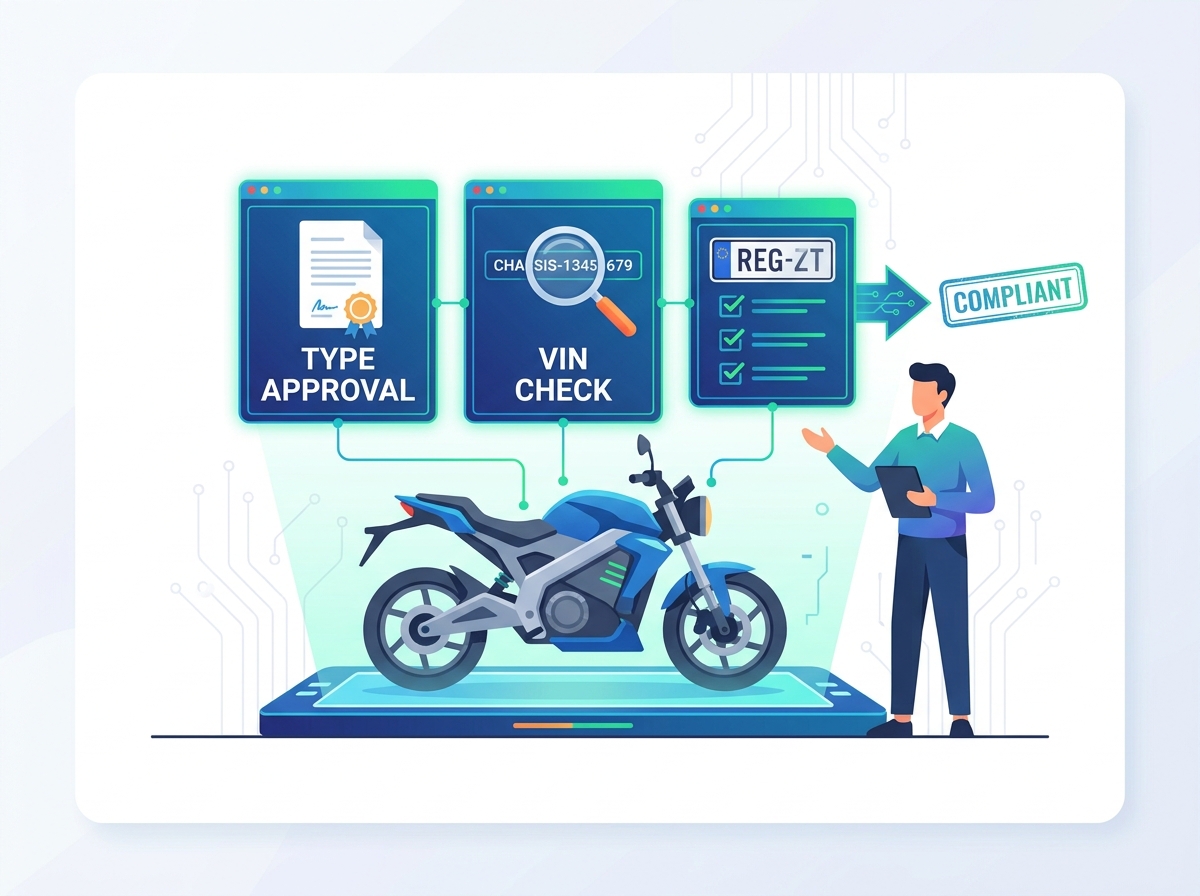
Strict compliance forms the absolute barrier to entry in the European electric mobility market. Documentation failures at customs result in seized shipments and unrecoverable capital. EEC certification acts as the definitive key to entering this regulated landscape. Buyers and distributors face a specific challenge: distinguishing between valid, verifiable compliance and superficial or fraudulent manufacturer claims. Importing non-compliant L-category vehicles carries severe financial and operational risks. You need a rigorous documentation audit framework covering homologation, VIN verification, and registration prerequisites. This ensures seamless customs clearance and legal road use. We will outline how to manage EEC electric motorcycle import documents effectively. You will learn to verify supplier claims and protect your import investments from border rejections.
CoC is Non-Negotiable: The Certificate of Conformity (CoC) tied to a valid Vehicle Type Approval is the foundational document required for both customs clearance and end-user registration.
Component vs. Whole-Vehicle Certification: Differentiate between component-level certifications (CE, LVD, EMC, RoHS) and whole-vehicle EEC homologation; component compliance does not guarantee road legality for an EEC electric motorcycle.
Traceability is Critical: VIN structures must perfectly align with statutory plates, clearance labels, and import paperwork to pass physical customs inspections.
Supplier Vetting: An electric motorcycle importer must evaluate overseas manufacturers based on their historical ability to provide verifiable, unexpired EEC documentation.
The Core Framework of EEC Electric Motorcycle Import Documents
Importing electric two-wheelers into the EU or EEC-aligned markets requires zero customs holds and immediate registerability. Success depends entirely on accurate, verifiable paperwork. Customs authorities scrutinize every shipment entering European ports. Missing, expired, or incorrect files trigger immediate manual inspections. These inspections delay delivery schedules and incur heavy demurrage charges. You must build a procurement strategy centered around document verification before any physical product ships.
The EU vehicle classification system categorizes these vehicles into specific L-categories. This classification dictates the exact documentation required for legal import. Customs agents will verify the declared category against the physical specifications of the vehicle.
L1e (Light Two-Wheel Powered Vehicles): This category covers low-speed mopeds restricted to a maximum speed of 45 km/h and a maximum continuous rated power of 4 kW.
L3e (Two-Wheel Motorcycles): This designates higher-performance motorcycles that exceed the 45 km/h speed limit or the 4 kW power threshold.
L4e (Two-Wheel Motorcycles with Sidecars): A specialized category requiring additional stability and braking homologation.
L5e (Powered Tricycles): Vehicles with three symmetrically arranged wheels equipped with an engine producing more than 4 kW.
An L3e vehicle faces stricter performance and safety audits than an L1e moped. Understanding the precise category of your imported goods ensures you request the correct testing reports and certificates from the factory. Misclassifying an L3e motorcycle as an L1e moped on your import declaration will result in immediate customs seizure.
EEC certification for an EEC electric motorcycle involves a rigorous, multi-stage testing process. It is never a simple self-declaration. Manufacturers must subject their vehicles to independent laboratory testing conducted by accredited technical services. Authorities evaluate braking systems, battery safety, and electromagnetic compatibility under strict laboratory conditions. Only vehicles passing these stringent physical tests receive official approval from national transport authorities.
Auditing Vehicle Type Approval and the Certificate of Conformity (CoC)
Understanding Electric Motorcycle Homologation
The electric motorcycle homologation process validates that a vehicle meets all regulatory standards required for public road use. National Type Approval (NTA) restricts sales to a single specific country. A vehicle approved in France under NTA cannot be legally sold or registered in Germany. European Community Whole Vehicle Type Approval (ECWVTA) allows sales across all EU member states. Commercial importers usually require ECWVTA to maximize market reach and simplify cross-border distribution.
Regional approvals differ significantly in their technical requirements. EU ECWVTA differs completely from EAC approval used in the Eurasian Customs Union or DOT/EPA standards in the United States. You must secure the exact vehicle type approval legally required for your specific target market. Submitting the wrong regional certificate guarantees customs rejection and forces you to re-export the goods at your own expense.
Homologation requires specific technical tests that evaluate the core safety components of the vehicle. Laboratories evaluate electromagnetic compatibility (EMC) under UN ECE R10 to prevent electronic interference with other vehicles or infrastructure. Battery safety falls under UN ECE R100 regulations. This standard mandates thermal shock, overcharge, over-discharge, and crush testing to prevent catastrophic thermal runaway events. Braking systems undergo rigorous performance trials under UN ECE R78 to ensure stopping distances meet legal minimums in both dry and wet conditions. Passing these evaluations translates directly into the final approval document.
The Role of the CoC in Customs and Registration
The Certificate of Conformity (CoC) acts as the manufacturer's official, legally binding declaration. It confirms that a specific vehicle, identified by its unique VIN, matches the approved type tested during homologation. Customs agents demand this document before releasing shipments to verify the goods meet European safety standards. Local transport authorities require the original physical CoC to issue license plates to the end consumer.
A valid CoC contains critical data fields that must be perfectly accurate. Customs officers will cross-reference these fields against the physical shipment.
Approval Number: The official alphanumeric code issued by the transport authority (e.g., e4*168/2013*00000*00).
Technical Specifications: Continuous rated power, top speed, vehicle dimensions, and mass in running order.
Emissions and Range Data: Energy consumption figures and maximum range tested under WMTC (World Motorcycle Test Cycle) standards.
Manufacturer Details: The legal name and registered address of the factory holding the type approval.
Missing data points or typographical errors render the document invalid and halt the registration process. You must review the draft CoC provided by the factory before authorizing the final print run.
Overseas suppliers sometimes present forged, altered, or expired CoCs to secure orders. Relying on unverified documents introduces massive operational risk. Customs authorities maintain direct access to homologation databases and will seize vehicles carrying fraudulent paperwork. You must implement a strict verification protocol before transferring any funds to a new supplier.
Always verify the e-mark and approval number printed on the provided sample CoC. Contact the issuing European transport authority directly to confirm the document's validity. Germany uses the KBA, the Netherlands uses the RDW, and the UK relies on the VCA. A quick database check confirms document authenticity, verifies the approval has not been revoked, and prevents catastrophic import failures.
VIN Verification and Physical Compliance Checks
WMI (World Manufacturer Identifier) and VIN Structure
The 17-character VIN standard follows strict ISO 3779 guidelines. The first three characters represent the World Manufacturer Identifier (WMI). The manufacturer must hold a registered WMI assigned by their national standards body to produce road-legal vehicles. This code identifies the country of origin and the specific manufacturer of the chassis. The Vehicle Descriptor Section (VDS) occupies the next six characters, detailing the vehicle type and platform. The final eight characters form the Vehicle Indicator Section (VIS), providing the unique serial number for that specific unit.
Customs authorities scrutinize the WMI during physical inspections. They use it to verify the true origin of the vehicle, cross-referencing it against the Certificate of Origin. Origin verification directly impacts anti-dumping duties and tariff applications. A mismatched WMI, or a WMI belonging to a different factory than the one listed on the commercial invoice, triggers immediate shipment holds and potential fraud investigations.
Physical Labels and Statutory Plates
Critical components require physical E-marks stamped directly onto the parts. Whole vehicle approval is not enough to pass a physical inspection. Specific parts like exhausts, mirrors, lighting fixtures, reflectors, and tires need separate EC Type Approval marks. This becomes especially critical when importing spare parts alongside whole vehicles. Customs will inspect the spares for compliance marks independently.
Statutory manufacturer plates must attach securely to the chassis, usually via rivets or permanent adhesive. Clearance labels reflect critical asset data required by port authorities. They indicate model changes, storage time, display status, and battery condition. Customs agents cross-reference these physical labels against the packing list to verify the declared value and physical condition of the shipment.
Matching Physical Assets to EEC Documentation
Importers must perform strict internal checks upon receiving goods at their warehouse. The physical VIN stamped on the frame must perfectly match the paperwork provided by the factory. You must establish a standard operating procedure for receiving inventory.
Locate the physical VIN stamped into the metal of the steering head or main frame.
Compare this 17-character string against the VIN printed on the original CoC.
Verify the VIN matches the commercial invoice and the packing list.
Check the statutory plate to ensure the type approval number matches the CoC.
Any discrepancy, even a single transposed digit, halts customs clearance and prevents the vehicle from ever receiving a license plate. You must quarantine any mismatched vehicles immediately and contact the supplier for corrected documentation.
Customs Clearance and Import Duties for an Electric Motorcycle Importer
Required Commercial Documents
An electric motorcycle importer needs a complete, error-free shipping file to clear goods efficiently. Standard commercial documents must accompany the technical homologation paperwork. You must provide a Commercial Invoice, a detailed Packing List, the Bill of Lading (B/L) or Sea Waybill, and a valid Certificate of Origin. Missing any of these standard documents guarantees port delays.
Absolute consistency across all documents is mandatory. Product descriptions must align perfectly across all pages, matching the exact model names listed on the CoC. HS codes cannot vary between the commercial invoice and the customs declaration. Discrepancies cause automated system rejections and trigger manual cargo inspections by customs officers.
HS Codes and Tariff Implications
Electric motorcycles typically fall under the 8711.60 Harmonized System (HS) code. This code covers motorcycles propelled by an electric motor. Correct classification dictates the base tariff rate applied at the border. Incorrectly classifying an L3e motorcycle as an electric bicycle to secure a lower tariff rate constitutes customs fraud and carries severe financial penalties.
Importing directly from Asian manufacturing hubs subjects the shipment to standard third-country tariffs. Intra-EU distribution works differently. Moving an already-cleared, compliant vehicle between EU member states incurs no additional import duties, provided the goods have achieved free circulation status. You must retain proof of initial customs clearance to facilitate smooth cross-border sales within Europe.
Proper classification and proof of origin impact your entire financial planning model. They determine the final assessment of import duties and Value Added Tax (VAT) required to release the goods. Misclassification leads to unexpected tax bills, profit erosion, and potential audits from national tax authorities long after the goods have been sold.
Navigating Anti-Dumping Regulations
Anti-dumping duties target specific manufacturing hubs, particularly in Asia, to protect domestic European industries. These punitive tariffs can exceed the commercial value of the goods, sometimes reaching over 70%. Accurate documentation prevents misclassification that might accidentally trigger these duties. Proper origin certificates protect you from unexpected tax liabilities. Always verify current trade regulations and active anti-dumping measures before finalizing factory orders.
End-User Registration Checks and Road Legality
Translating Import Documents to License Plates
The journey from customs release to the local Department of Motor Vehicles requires precise document handling. Once customs clears the shipment, the end-user or dealer takes the original physical CoC, the commercial invoice, and proof of insurance to the local registration office. Copies or digital scans of the CoC are almost universally rejected by registration authorities.
EEC Type Approval applies EU-wide, but administrative processes vary by country. Local registration bodies maintain specific requirements for processing the CoC. Some countries require physical vehicle inspections for imported goods, while others process registrations entirely online using the data fields provided on the CoC. You must understand the specific registration mechanics of your target market to support your dealer network effectively.
Insurance and Taxation Documentation
The technical data printed on the CoC dictates downstream financial requirements for the buyer. Insurance companies use continuous rated power and top speed figures to assign risk categories and calculate premiums. Local governments use the same data to determine road tax brackets and eligibility for green vehicle subsidies. Accurate CoC data ensures end-users pay the correct insurance premiums and receive applicable tax benefits, directly impacting customer satisfaction.
Implementation Risks and Vendor Evaluation Framework
Vetting suppliers thoroughly prevents costly compliance mistakes. Ask direct, technical questions during initial negotiations. Do they own the approval, or do they piggyback on a trading company's certificate? Demand a high-resolution sample CoC for verification before paying any deposit. Manufacturers who hesitate to share approval documents usually do not possess valid certification.
Fully homologated, compliant vehicles carry a higher unit cost. Testing and certification require massive financial investments from the factory, often taking months to complete. Undercutting market prices usually indicates missing, expired, or fraudulent documentation. You cannot secure a fully compliant L3e motorcycle at the cost of an unregulated electric bicycle.
Verification Step
Action Required
Risk if Ignored
CoC Authenticity
Cross-reference approval number with EU transport authority database.
Customs seizure, vehicle destruction, and loss of capital.
VIN Matching
Compare physical chassis stamp to commercial invoice and CoC.
Clearance delays, port storage fees, and registration failure.
Component E-Marks
Inspect mirrors, lights, tires, and reflectors for physical EC marks.
Failure during local roadworthiness tests and safety recalls.
WMI Registration
Verify manufacturer identifier in the official ISO database.
Anti-dumping duty penalties and origin fraud investigations.
Common Documentation Pitfalls
Many importers fall into common documentation traps that destroy their profit margins. Accepting component-level CE marking as whole-vehicle approval is a fatal error. Low Voltage Directive (LVD), EMC, and RoHS apply to basic electronics, not road legality. Micro-mobility standards like EN15194 for pedelec e-bikes or UL2272 for hoverboards cannot substitute for L-category EEC homologation. You must demand ECWVTA documentation for any vehicle intended for public road use.
Conclusion
Disqualify any manufacturer that hesitates to provide verifiable approval numbers and sample CoCs during initial negotiations.
Engage a licensed customs broker with specific EV experience to review all commercial and compliance documents before authorizing shipment.
Conduct a small-batch trial shipment to stress-test the manufacturer's documentation process and customs clearance efficiency.
Establish an internal audit checklist to verify VINs, E-marks, and clearance labels immediately upon arrival at your warehouse.
FAQ
Q: What is the difference between CE and EEC certification for electric motorcycles?
A: CE applies to specific components and electronics regarding health and safety, including LVD, EMC, and RoHS directives. EEC certification, or homologation, applies to the entire vehicle's road legality and safety standards. CE alone does not make a motorcycle road-legal.
Q: Can I import an electric motorcycle without a Certificate of Conformity (CoC)?
A: No. For road-legal L-category vehicles, a CoC is mandatory. You need it for clearing customs and registering the vehicle for a license plate in the EU. Without it, the vehicle cannot be legally driven on public roads.
Q: How do I verify a vehicle type approval certificate?
A: Cross-reference the e-mark and approval number printed on the certificate with the issuing national transport authority. Agencies like the RDW in the Netherlands or the KBA in Germany maintain databases to confirm document authenticity.
Q: What happens if the VIN does not match the EEC electric motorcycle import documents?
A: Customs authorities will flag the shipment for inspection. This mismatch likely results in seized goods, mounting port storage fees, and potential destruction of the non-compliant vehicles. Exact matching is strictly enforced.
Q: Are import duties different for EEC-certified electric motorcycles?
A: EEC certification itself doesn't change the base tariff rate. However, proper documentation ensures correct classification under the HS code, avoiding punitive fines for misdeclaration. Compliant vehicles moving intra-EU face no additional import duties.
Q: How much does electric motorcycle homologation cost?
A: Homologation represents a significant investment for the manufacturer. It often costs tens of thousands of euros per model due to rigorous laboratory testing. This high cost is why fully compliant vehicles carry a higher wholesale price.
Q: Do clearance labels on electric motorcycles matter for import?
A: Yes. Statutory plates and clearance labels must be physically attached to the vehicle. They must accurately reflect the manufacturer, VIN, Type Approval number, and asset status, such as storage time or battery condition, perfectly matching the paperwork.
Beneath the Tianshan Mountains in June, sweet fruits fill the air and bustling business exchanges thrive. On June 25, 2026, the 9th China-Eurasia Expo grandly kicked off in Urumqi, Xinjiang. As an influential comprehensive international event along the Belt and Road Initiative, this year’s expo hit
From May 26 to 29, the highly anticipated "Comprehensive Upgrade, Leading the Future with Intelligence" JP Group 2026 Business Summit & New Product Launch grandly kicked off at Xiamen International Expo Center.